[WASHINGTON, D.C., July 23, 2026] — Artificial intelligence (AI) is rapidly changing how young people learn, communicate, seek support, and navigate everyday challenges. AI chatbots and tools are becoming an increasingly common part of daily life for young people, offering everything from academic assistance and creative collaboration, to social interaction and emotional support. While many young people report positive experiences with these technologies, there is growing concern about their impact on mental health, development, and well-being.
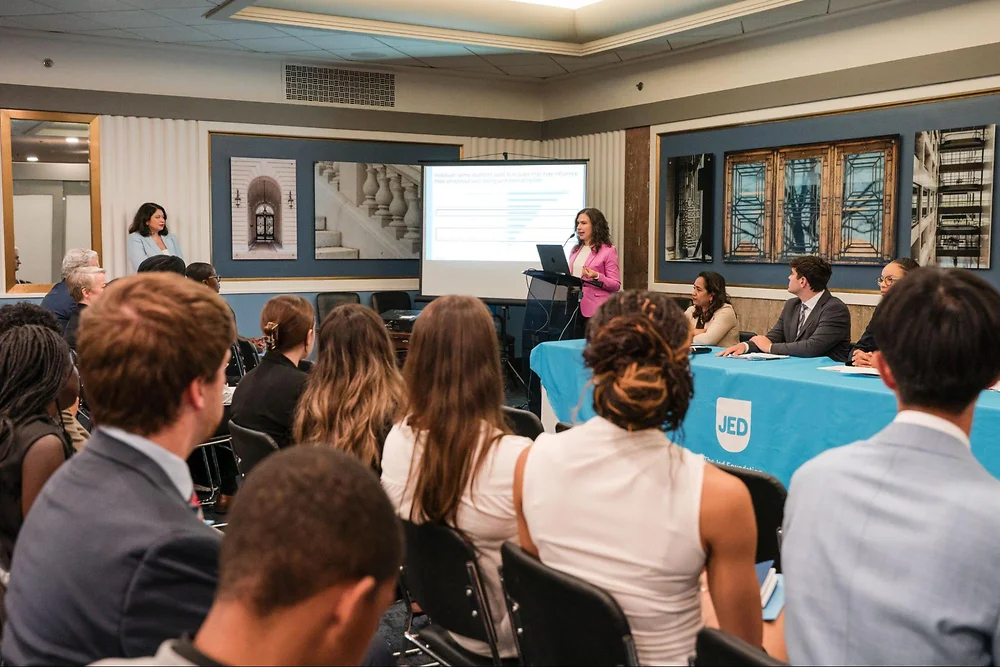
On July 21, The Jed Foundation (JED), a leading nonprofit that protects emotional health and prevents suicide for teens and young adults nationwide, gathered over 200 congressional staff, policymakers, youth advocates, researchers, and mental health leaders for a bipartisan briefing on Capitol Hill, “Navigating AI: Youth Perspectives, Mental Health, and Public Policy.” The briefing provided a preview of findings from original JED research – expected to be released this fall – led by Dr. Kayla Anderson, JED’s vice president of research and evaluation.
Between October 2025 – April 2026, JED collected data from more than 5,500 middle and high school students across 21 U.S. schools and school districts enrolled in JED’s programs about how they use artificial intelligence (AI). Key findings include:
- AI use is very common: 4 in 5 students used some type of AI.
- Some students use AI in ways that replace human interaction or support: While more than half of students use AI for academics, nearly one third of students use AI for relationship or problem-solving advice and more than one in ten talk to AI for companionship.
- Many students turn to AI when experiencing difficult emotions: Nearly 3 in 5 students used AI when they felt sad, stressed, or lonely.
- AI use differs by age and geography: High school students and rural students were more likely to use AI overall. Middle school students and urban students were more likely to use AI specifically when they were sad, stressed, or lonely.
- AI use has potentially profound implications for mental health, loneliness, and suicidal thoughts and behaviors: Students who used AI for emotional or mental health support, for problem-solving advice, when experiencing difficult emotions, or for companionship were more likely to have poorer mental health, were more lonely, and had a greater history of suicidal thoughts and behaviors.
“AI is already deeply embedded in how young people learn, build relationships, solve problems, and seek support, and JED’s preliminary findings underscore the urgency of understanding what that means for their mental health,” said Dr. Zainab Okolo, JED’s senior vice president of policy, advocacy, and government relations. “Unlike many adults who remember life before constant digital connection, today’s young people are growing up with AI as an increasingly intimate part of their social, academic, and emotional lives. Their experiences and perspectives must therefore be central to the policies governing these technologies.”
The briefing was led by Dr. Okolo with keynote addresses from JED CEO John MacPhee and Dr. Stephanie Haridopolos, principal deputy assistant secretary for health policy and director of national health communications in the office of the Surgeon General. Dr. Haridopolos shared her office’s most recent Warning on the Harms of Screen Use, which addresses emerging concerns about how children are interacting with chatbots.
“We are calling for urgent action to protect children at home, in schools, and across platforms,” said Dr. Haridopolos. “Kids are growing up in digital spaces that were never designed for their safety, and these online experiences are shaping how they think, feel, and interact in real life. We want children to live real life, not be pulled into harmful environments online. The recently released Surgeon General’s Warning on the Harms of Screen Use gives families and communities the guidance they need. History will judge us not only by the steps we took, but by the inaction we allowed.”
Panelist Hanae Noirbent, a member of JED’s Youth Advisory Council (YAC), shared her perspective on how youth can be protected from potential harms posed by AI. “Youth are already interacting with AI on a day-to-day basis,” she said. “We want guardrails implemented that will protect us from the clear risks presented by AI-powered algorithms and generative AI platforms such as chatbots. We also know that there’s a real opportunity for AI to serve as an educational support tool, and even as a tool that directs us to lifesaving resources such as the 988 Suicide and Crisis Lifeline.”
Other panelists included Allie Maloney, policy analyst at Americans for Responsible Innovation, Blake Hurst, JED YAC member and student at University of Notre Dame, and Bhavani Kola, department chair at Tarrant County College and founder and CEO of Eclatech Solutions. They discussed how states are responding to these technologies, opportunities and risks for youth mental health and well-being, and considerations for future federal policymaking.
This is the second AI-focused briefing hosted by The Jed Foundation since they published recommendations for policymakers and tech companies.
View photos of the event. To learn more about JED’s policy, advocacy, and government relations work, visit JED’s website.
###
About The Jed Foundation
JED is committed to protecting emotional health and preventing suicide for our nation’s teens and young adults. JED partners with high schools, colleges, school districts, and youth-serving community-based organizations to strengthen their mental health, substance misuse, and suicide prevention programs and systems. JED equips teens and young adults with the skills and knowledge to help themselves and each other, and encourages community awareness, understanding, and action for young adult mental health.
Connect with JED: Email | LinkedIn | Instagram | Facebook | TikTok | Snapchat | YouTube
Media Contact
Justin Barbo
PR Director
The Jed Foundation
[email protected]