
Youth Mental Health in the Age of AI Featured at The Jed Foundation (JED) Third-Annual Policy Summit
National leaders across mental health, education, philanthropy, policy, and youth advocacy sectors unite to advance sustainable solutions and protect the emotional well-being of young people.
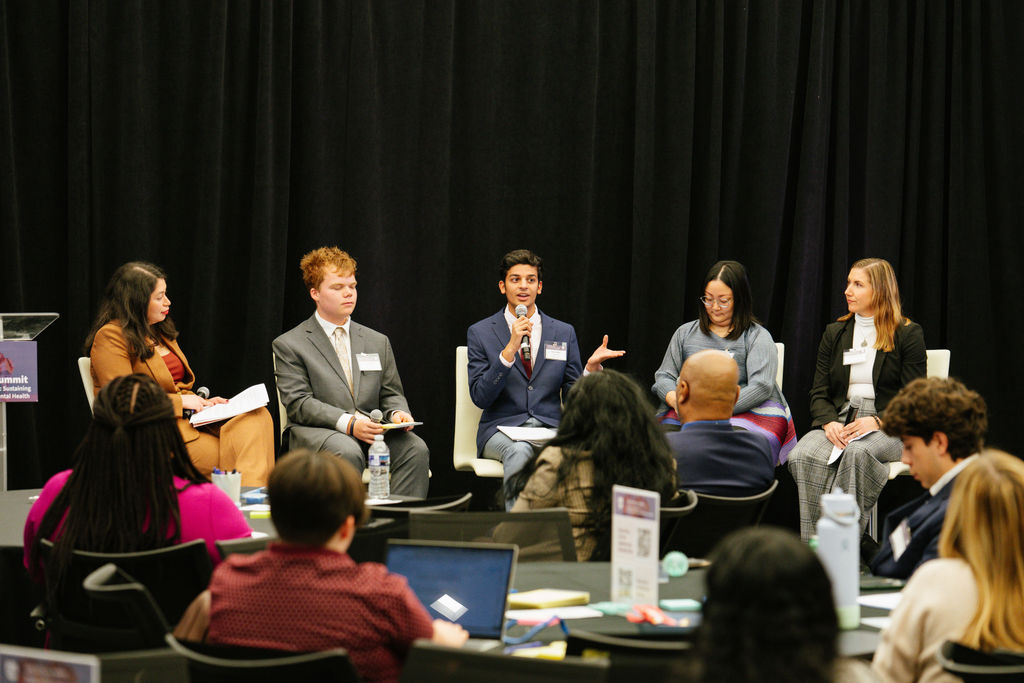
[October 21, 2025, Washington, D.C.] — The Jed Foundation (JED), a leading nonprofit that protects emotional health and prevents suicide for teens and young adults nationwide, gathered mental health experts, policymakers, advocates, educators, and young people for its third-annual policy summit in Washington, D.C., on October 15. The summit, “Meeting the Moment: Sustaining Progress in Youth Mental Health,” focused largely on the growing influence of artificial intelligence (AI) and the role of legislative policies on the local, state, and federal levels in shaping mental health support, investments, and resources for students in the digital age.
The summit began with an inspiring introduction and framing of the moment by Dr. Zainab Okolo, JED’s senior vice president of policy, advocacy, and government relations, who reflected on the national policy landscape and what it means to sustain progress. She debuted JED policy framework, AI Policy Levers for Youth Mental Health, which calls for:
- Regulation: Establishing ethical guardrails for how AI interacts with youth in schools, health systems, and digital spaces
- Funding: Investing in innovation that is youth-informed and in evidence-based tools that support connection rather than replace it
- Coordination: Creating alignment across education, technology, and public health so that AI expands access to mental health resources rather than exacerbating gaps.
“The mental health and safety of our young people is not a partisan issue. It’s a shared national priority. JED’s summit underscored the absolute necessity of bipartisan collaboration,” said Dr. Okolo. “We must work across the aisle — among policymakers, technology leaders, or advocates — to forge solutions that secure resources and investments in vital mental health services and establish ethical, protective guardrails around emerging technologies. Our youth deserve nothing less than a united front dedicated to their well-being.”
Michael Satow, JED’s board chair, offered opening remarks grounded in heartfelt thoughts about his brother, Jed, after whom the organization is named, while praising the summit for leaning into conversations about safeguarding the emotional health of youth in digital and school spaces.
“More than two decades after losing my brother Jed, our family continues processing a loss that may never fully make sense, but what we can do is ensure no other family endures this pain alone. This summit represents the kind of forward-thinking dialogue we need, examining how emerging technologies like AI intersect with youth mental health and suicide prevention, and translating those insights into actionable pathways that strengthen communities and save lives,” Satow said. “By sustaining these critical conversations and implementing evidence-based frameworks — like JED’s Comprehensive Approach to Mental Health Promotion and Suicide Prevention — that build connection, reduce risk, and expand access to care, we move closer to a future where every young person has the support they need to thrive.”
Summit participants also discussed new National Survey on Drug Use and Health (NSDUH) data that offers hopeful signs about youth mental health trends, showing declines in depression, suicidal thoughts, and suicide attempts among many demographics of teens and young adults from 2021 to 2024. While these findings underscore the impact of dedicated efforts in youth mental health and suicide prevention, this progress is being challenged. Federal budget cuts have put mental health services and adjacent supports at risk, from Medicaid and school-based programs to 988 crisis line services and youth-specific resources. Simultaneously, AI and evolving technologies are presenting significant safety issues to the mental health and well-being of youth.
“Recent national data from 2024 and 2023 shows overall declines in youth depression and suicidality, offering a powerful beacon of hope, validating the tireless work of so many dedicated to youth mental health. However, these improvements were not experienced across all groups of youth, showing that youth suicide prevention remains an urgent priority, and that the progress made is uneven and fragile. Therefore, we must remain committed in our resolve to this work and mission,” said John MacPhee, JED’s CEO. “As we face federal budget cuts to essential services and confront the alarming new risks for youth posed by unregulated AI development, JED’s third-annual summit was more vital than ever. JED remains committed to working with leaders across sectors to ensure that young people’s safety is a top priority.”
Congresswoman Becca Balint (VT-AL) highlighted a bipartisan bill, co-sponsored with Congressman Bryan Steil (WI-01), that aims to strengthen youth mental health supports by expanding access to care, aligning federal resources, and incentivizing cross-sector partnerships. Her remarks underscored how federal legislation can sustain progress, advance equity, and provide practical solutions for states, campuses, and communities.
“Despite the strides we have made to normalize mental health, this topic can still be incredibly hard for people to talk about, especially for young people. It’s complex. It’s personal. It can be scary and overwhelming,” said Rep. Becca Balint. “Today, I’m so proud to join JED for their policy summit to bring together experts, advocates, and young people with a common goal of addressing mental health challenges and the impacts of social media and AI. It’s more critical than ever that we take real steps to require technology companies to implement safeguards and provide our youth with the resources they need and deserve.”
Members of JED’s Youth Advocacy Coalition, including the 2025 JED Texas Youth Advocacy Coalition Fellowship Cohort, shared insights and recommendations rooted in what they identified as disconnects between youth needs and adult-led policy agendas.
“As a JED Texas Youth Advocacy Coalition fellow and event panelist, the policy summit felt like a true seat at the table,” said Rohan Satija, 2025 JED Texas Youth Advocacy Coalition fellow and 2025 JED Student Voice of Mental Health Award high school honoree. “I felt like my lived experience was heard and taken into account, helping shape policy. I’m excited to implement the insights I learned from the summit in my own community.”
Additional discussions and priority topics at this year’s summit included:
- Youth mental health and the role of AI: Experts in suicide prevention and public health highlighted how federal research and surveillance data are informing prevention strategies, and how AI-driven tools intersect with broader public health priorities and risks.
- Guardrails for the future of AI, mental health, and responsible innovation: Panelists explored and evaluated frameworks to understand AI’s risks and benefits, alongside tech-related policy recommendations.
- State systems in action: State education leaders offered blueprints for scaling behavioral health models and prioritizing youth mental health in their strategic planning and budgeting to address youth mental health.
Featured policy summit speakers, panelists, and participants also included:
- United States Senators Alex Padilla (D-CA), Marsha Blackburn (R-TN), and Richard Blumenthal (D-CT)
- Dr. Harold S. Koplewicz, president of the Child Mind Institute
- Rafael Campos, former deputy director of public engagement at the Office of the Surgeon General
- Nicole “Nikki” Clifton, president of The UPS Foundation
- Kody Kinsley, former Secretary of Health and Human Services for the state of North Carolina
- Dr. William A. Smith, chief executive administrator at Huntsman Mental Health Institute
- Hollie Chessman, director and principal program officer at American Council on Education
- Jennifer Wang, senior director of policy and communications at Fountain House
- Dr. Tony Walker, JED’s senior vice president of school programs and consulting; Dawn Thomsen, JED’s senior vice president of youth strategies and chief engagement officer; and Martha Sanchez, JED’s director of policy
- Representatives of organizations including Active Minds, American Foundation for Suicide Prevention, Annie E. Cassie Foundation, Common Sense Media, Gates Foundation, Mental Health of America, One in Five, RAND Social and Economic Well-Being, State Higher Education Executive Officers Association, Third Way, and Trellis Foundation
The policy summit was sponsored by the Trellis Foundation and the Lumina Foundation.
View photos from the summit. For more information on JED’s policy, advocacy, and government relations work, please visit our website.
Interviews available with John MacPhee, JED’s CEO, and Dr. Zainab Okolo, JED’s senior vice president of policy, advocacy, and government relations, as well as with youth voices from the summit.
##
About The Jed Foundation (JED)
JED is a nonprofit that protects emotional health and prevents suicide for our nation’s teens and young adults. We’re partnering with high schools, colleges, and school districts to strengthen their mental health, substance misuse, and suicide prevention programs and systems. We’re equipping teens and young adults with the skills and knowledge to help themselves and each other. We’re encouraging community awareness, understanding, and action for young adult mental health.
Connect with JED: Email | LinkedIn | Instagram | Facebook | TikTok | Snapchat | YouTube
Media Contact
Justin Barbo
Director of Public Relations
The Jed Foundation
Justin@jedfoundation.org
How JED Helped Macaulay Honors College Make Mental Health Central to Student Success
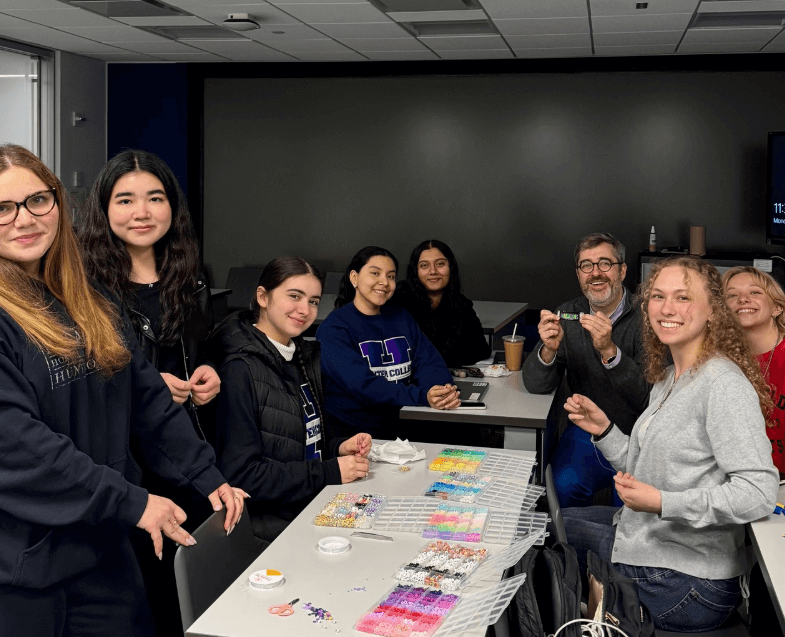
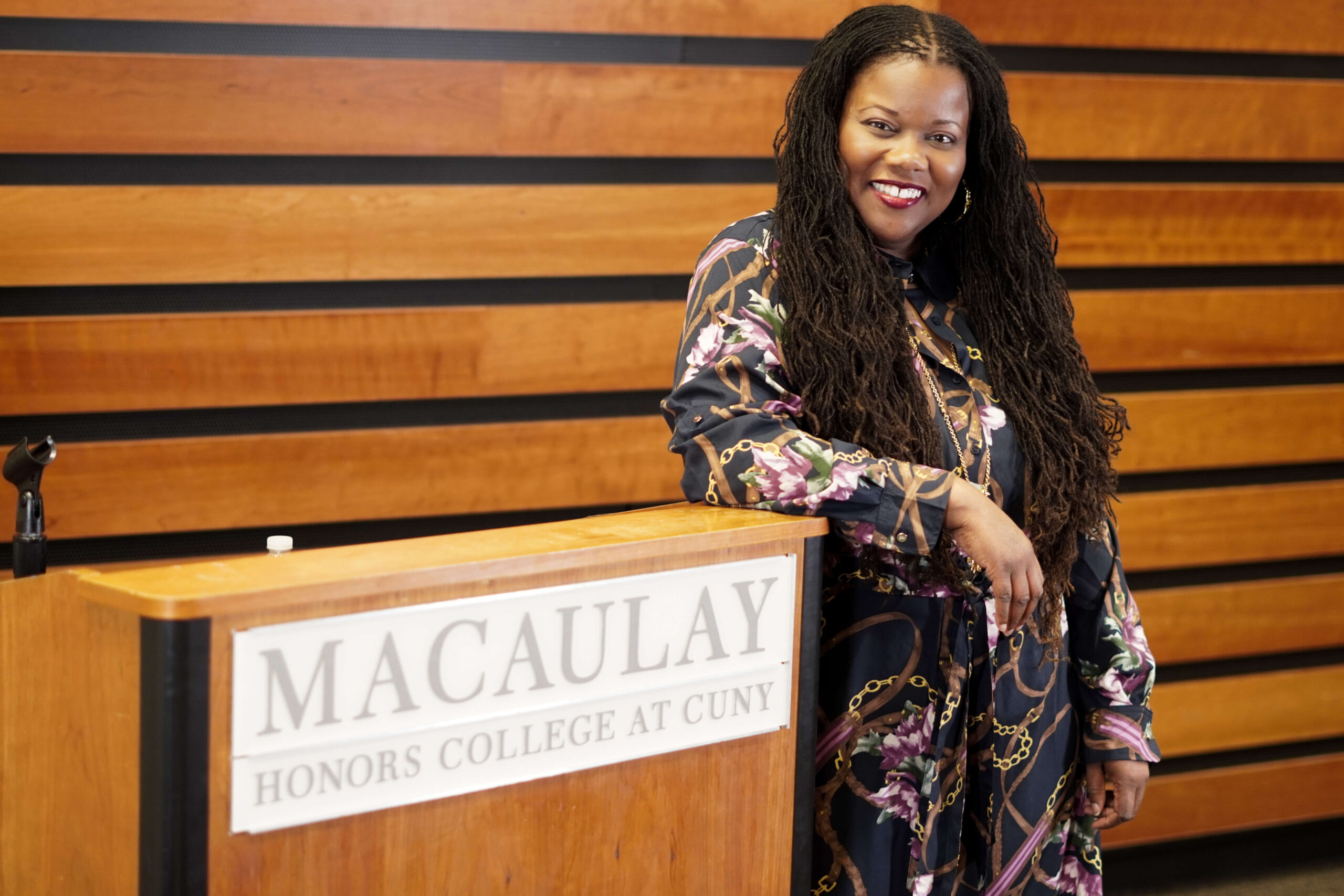
When Dara Byrne became dean of CUNY’s Macaulay Honors College in 2022, she encountered a paradox. Some of the city’s most accomplished students were facing some of its heaviest burdens.
Macaulay students are among New York’s most talented and ambitious. They’re graduates of specialized high schools with top grades, scholarships, and big expectations for their futures.
But beneath all that are the daily realities that make the climb even harder: Many face long commutes across the city, family responsibilities, and the weight of being the first in their families to go to college.
“From the time they’re in high school, our students are told that they could go to medical school or become a lawyer, and in many cases, they will be the ones to lift their families out of poverty,” Byrne says. “That’s an extraordinary amount of pressure to carry.”
Even before Dean Byrne’s arrival, Macaulay had begun laying the groundwork for student mental health. The college’s newly established Counseling Center provided essential one-on-one support — especially during and after the pandemic, when demand for care surged. But with limited capacity, the focus remained on crisis response rather than the kind of proactive, community-based wellness programming that helps all students thrive.
“When I came in, it was clear that our students had needs, but we also had to understand what those needs were and how to meet them effectively,” Byrne recalls.
That’s where The Jed Foundation (JED) came in. Partnering with JED helped Macaulay better understand the mental health needs of its students, and design practical programs to meet those needs
“JED gave us the tools and framework to do what we always wanted to do — support students not just when they’re in crisis, but in their everyday lives,” Byrne says. “They helped us begin the work of building wellness into the very fabric of what it means to be part of the Macaulay community.”
Finding a Framework
That shift from crisis response to proactive wellbeing began when Macaulay first joined the JED Campus Fundamentals program — an 18-month program designed to help schools identify their top priorities and lay the groundwork for holistic mental health support. But school leaders soon realized the depth of change they wanted required more. That’s when they moved into the full JED Campus initiative, a multi-year partnership that guides schools through systemwide improvements.
The appeal wasn’t a flashy new resource; it was the promise of a process.
JED’s campus advisors helped Macaulay take a step back and look at the whole picture. What was working in their approach to student mental health? Where were the gaps? How could mental health support become part of the whole college’s DNA, not just the counseling office?
What the Process Looks Like
For Macaulay, JED’s recommendations became a roadmap for strengthening student support across the college.
With guidance from JED’s advisors, the college developed clearer steps to ensure students in distress could be identified and connected to help more quickly and consistently. One of the most important changes was the creation of a “postvention” plan — a set of campus-wide procedures for responding with care and coordination in the aftermath of a tragedy.
A “Red Folder” initiative equips faculty and staff with practical tools to recognize signs of distress and refer students to the right campus resources. Faculty are trained to identify early warning signs, fostering a culture of shared responsibility for student well-being.
At the same time, Peer Wellness Ambassadors are building bridges across the community through workshops, peer-led discussions, and events exploring topics like belonging, stress management, and neurodiversity. Regular needs assessments provide leadership with a data-informed picture of emerging trends and gaps. Expanded wellness programming through a new model led collaboratively by students and staff enables counselors to increase their capacity and devote more time to individualized one-on-one counseling.
Taken together, these steps fit in naturally with JED’s Comprehensive Approach to Mental Health Promotion and Suicide Prevention — from fostering life skills and connectedness to ensuring access to care and preparing for crisis response — but they felt wholly like Macaulay’s own.
“It was like FEMA for higher ed,” Byrne says. “Not just rushing in after a disaster, but preparing for the future”

Students Leading Students

One of the clearest signs of change hasn’t come from administrators at all — it’s come from students.
Early on, Peer Wellness Ambassadors began organizing campus-based events to bring peers together around themes of connection, balance, and self-care. What started as small gatherings quickly grew in popularity, consistently drawing more students than expected. These events offer a non-stigmatizing way to talk about wellness, creating spaces for students who might otherwise feel isolated to find community, and encouraging those hesitant to seek counseling to take that first step.
Building on that momentum, Peer Wellness Ambassadors co-organize Macaulay’s Wellness Symposium, a large-scale, student-centered event focused on community and belonging. The first symposium drew a standing-room-only crowd and elevated the visibility of student-led wellness initiatives across the college. It also reinforced a core truth of Macaulay’s evolving approach to mental health: when students lead the conversation, participation deepens, stigma fades, and the entire community becomes stronger.
The Results
The cultural shift is visible in numbers as well as stories. Since beginning its work with JED in 2021, Macaulay has seen:
- Participation in wellness programs jumped from fewer than 100 students to more than 1,000.
- Nearly half the student body engaged in mental health and wellness activities.
- 2,295 unique visits to a new online wellness hub — more than the total enrollment of the college.
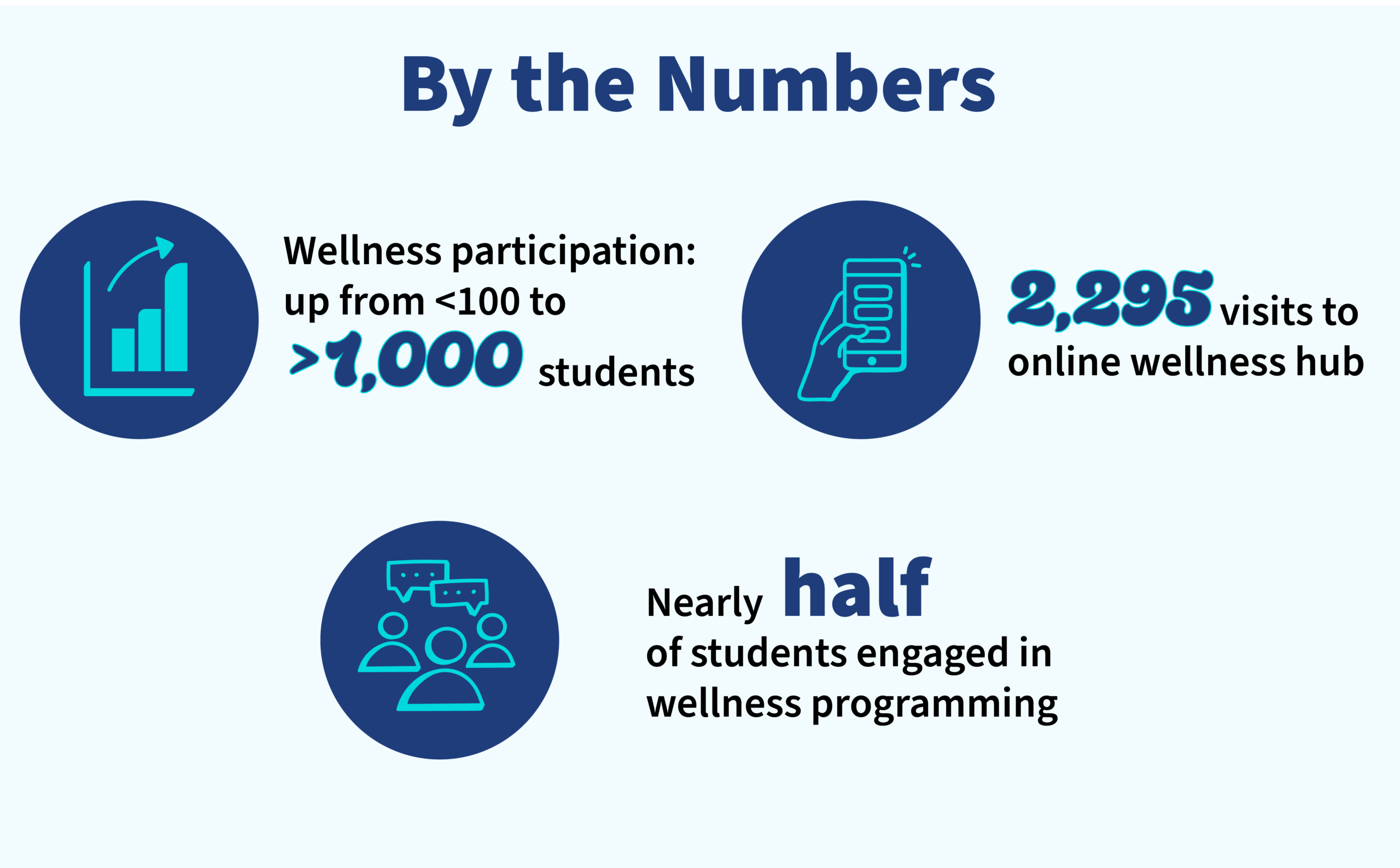
For Byrne, these numbers aren’t just impressive metrics; they’re proof that the work is reaching students who once might have slipped by unnoticed.
A Culture of Care, Baked In
Today, wellness is not an add-on at Macaulay. It’s part of the College’s new strategic plan, guiding decisions across advising, academics, and student life. The systems built with JED’s framework are designed to last, and to keep evolving as new challenges emerge.
“We’re seeing a real cultural shift,” Byrne says. “Students are showing up for wellness events, they’re talking openly about their experiences, and they’re helping each other feel seen. That tells me the foundation we’re building is working—and that we’re moving toward a truly caring community.”
Learn more about bringing JED to your campus, or donate to help JED bring its lifesaving work to more young people nationwide.
Her 14-year-old was seduced by a Character.AI bot. She says it cost him his life.
Faculty at Eastern Michigan University Rally Around Mental Health After a Colleague’s Loss
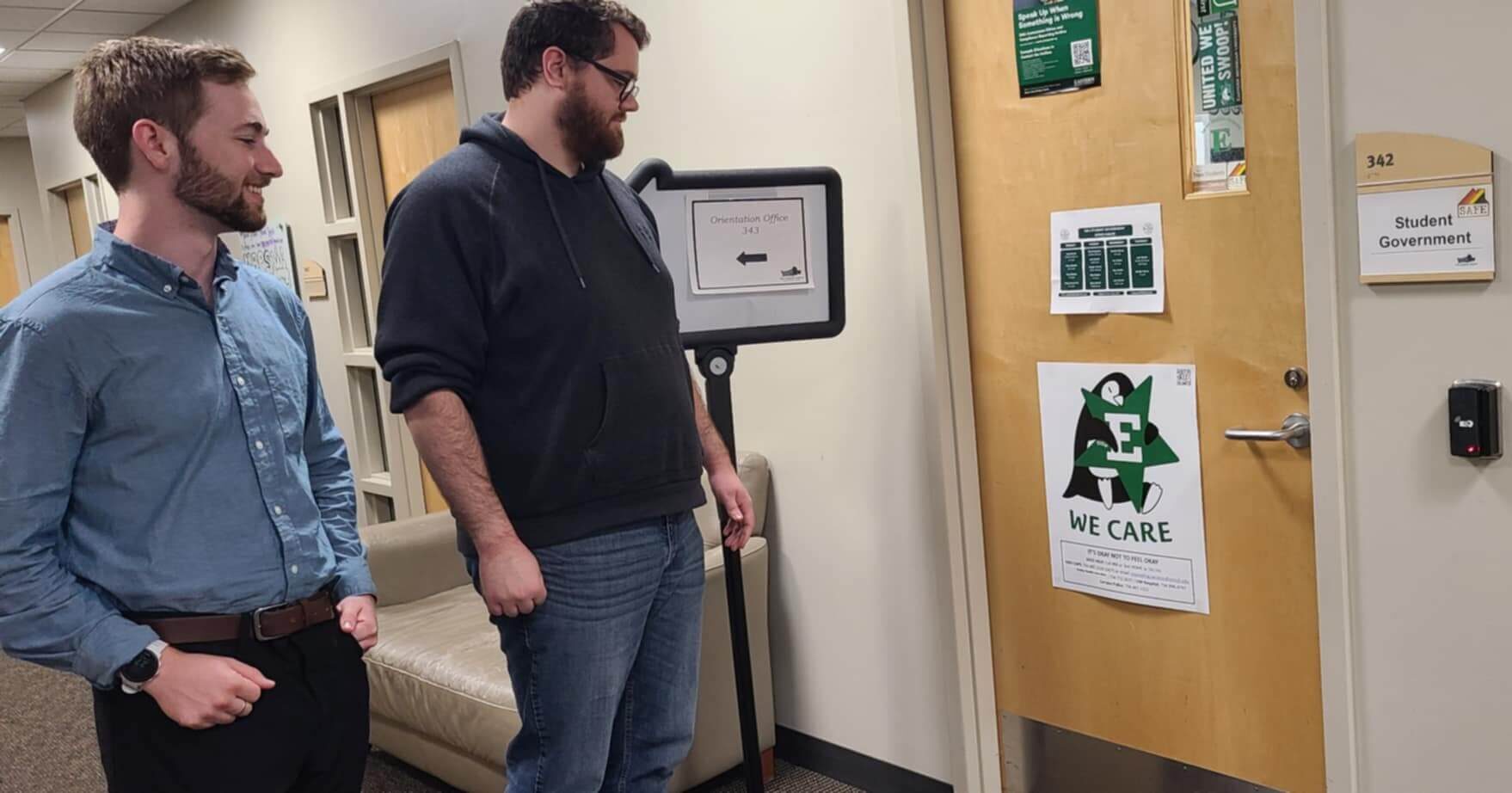
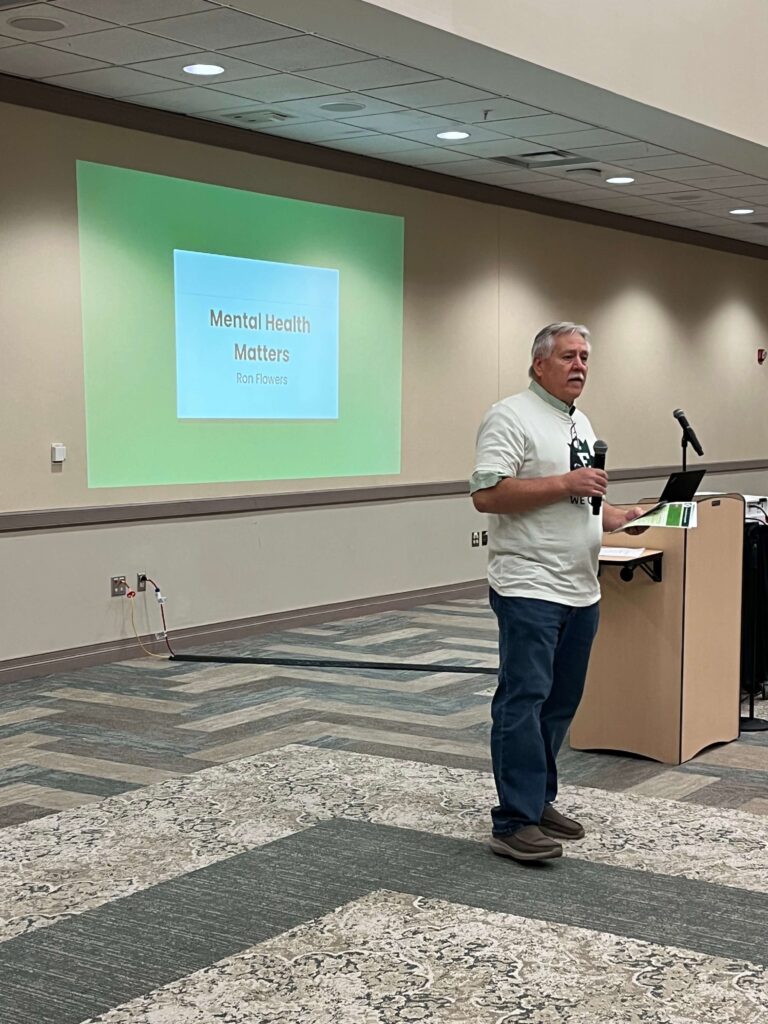
The loss of his son to suicide in 2022 left Ronald Flowers, a professor of Leadership and Counseling at Eastern Michigan University (EMU), reeling and searching for answers. “I wouldn’t wish this tragedy on anybody,” he said.
Support from colleagues came quickly, and with it, a campus-wide movement to promote mental health, guided by The Jed Foundation (JED).
“Right after, the Provost — a longtime friend — asked me, ‘What do you need? How can we support you?’” Flowers recalled.
That moment set EMU on a new path.
Within weeks, Flowers and colleagues launched a campus-wide task force on mental health. When the call for volunteers went out, more than 30 faculty members signed up in a single day.
“Normally, it’s like pulling teeth to get people to serve on committees,” he says. “This was different.”
From Diagnosis to Action
With JED’s support, the first step was to survey students, faculty, and staff.
“Some questions were challenging to answer,” Flowers says. “Others were illuminating — things we’d never thought about before. It made us realize how much we didn’t know.”
Faculty and staff saw both strengths and gaps as they worked through JED’s comprehensive assessment, a structured process that looks at four key areas: how students are supported in building resilience and life skills, whether early signs of distress are being noticed, how available and accessible clinical services are, and how safe the campus environment feels.
There was strong crisis intervention, but weaker support for everyday stress and anxiety. “The question became, How do we keep them on the thriving side?” Flowers said.
Instead of producing another report, the group set out to act.
Small Steps, Steady Change
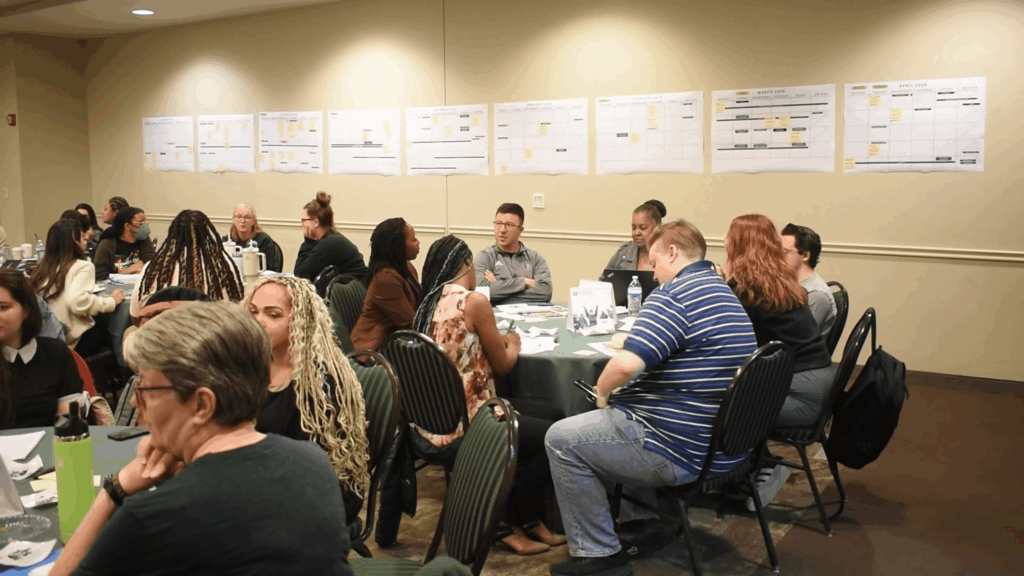
The task force now has 27 members: faculty, staff, service providers, and students. Guided by JED’s approach, they work in subgroups, each choosing one or two goals for the year.

Instead of letting the scale of the problem overwhelm them, EMU broke the work into achievable pieces.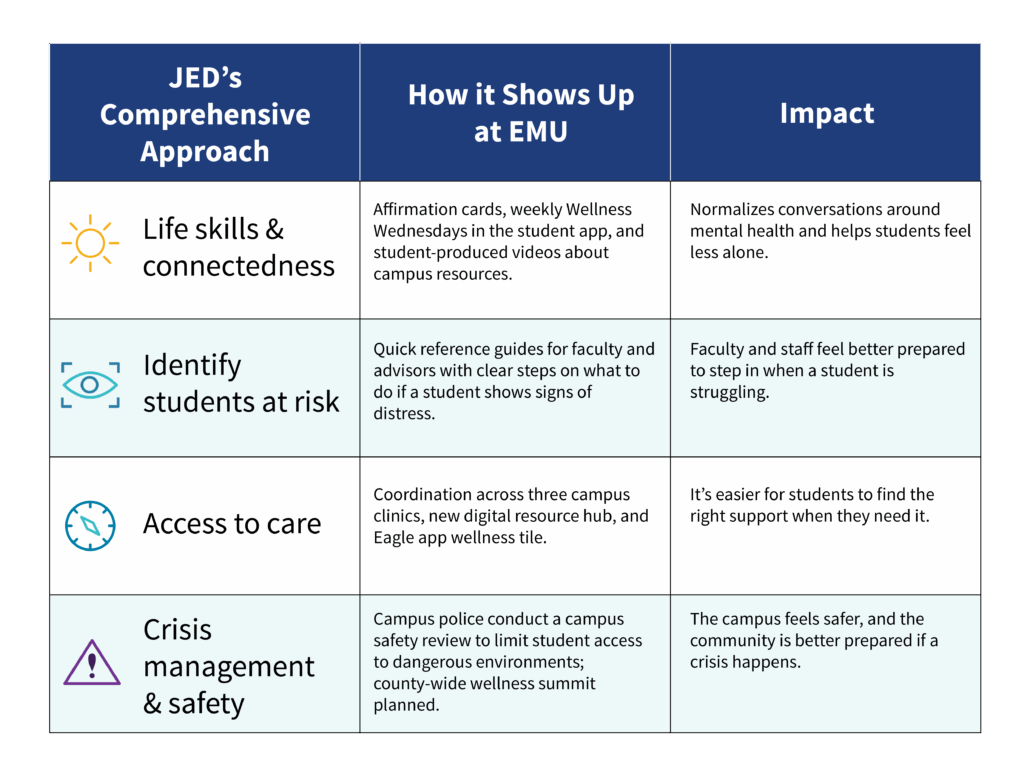
Among those steps:
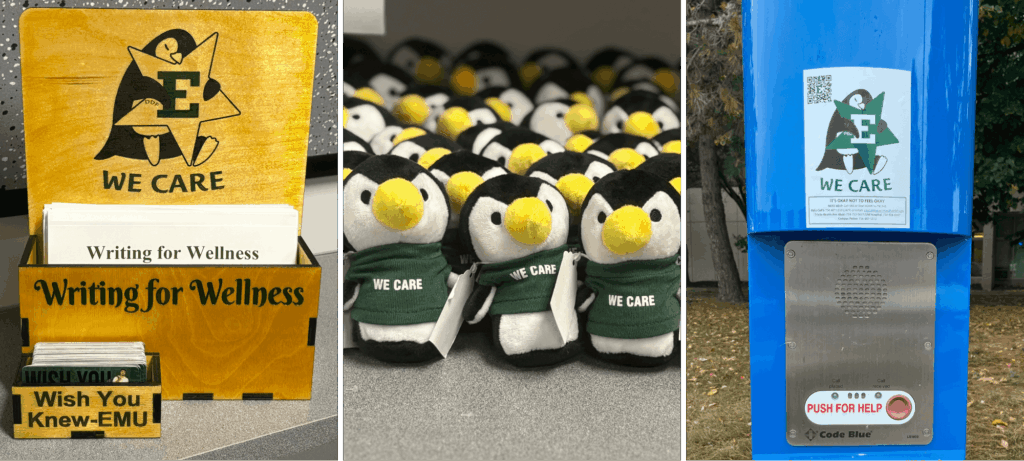
- The “We Care” campaign: Posters, mugs, and stickers carrying a logo Flowers designed with his son before his death. These visible reminders have helped normalize conversations about mental health across campus.
- “Wish You Knew” EMU cards: Pocket affirmations with QR codes linking to resources. They reduce stigma and make help-seeking feel less intimidating.
- Quick Reference Guides: For faculty and advisors on how to respond when a student is in distress. Faculty report feeling more prepared and confident when concerns arise.
- Wellness Wednesdays: Weekly push notifications through the EMU Eagle app for students. These regular touchpoints give students timely strategies and affirmations, reinforcing resilience week by week.
- Campus Safety Review: Conducted by campus police, with emergency contacts posted across facilities. These audits help limit student access to dangerous environments.
- Parent Newsletter: A new resource to engage families in student mental health.
- Mental Health Website Resource page: This provides a centralized hub of information to empower students, faculty, and staff with evidence-based information, local service directories, and expert insights tailored to support emotional well-being.
“Lots of little things, cumulative in their effect. And then big things start to happen,” Flowers says.
Students as Partners
Flowers knew that for the work to be most effective, students would have to build it with them, a priority built into JED’s model.
The student government meets regularly with the task force. Undergraduates have produced short videos that walk their peers through the counseling center and food pantry, making it easier — and less intimidating — to use those resources.
Student workers also helped design the new mental health website and app so that it feels approachable rather than bureaucratic.
For Kati Lebioda, Assistant Professor of Leadership and Counseling at EMU, said the effort has also reshaped her own early career. “I’ve only been here a year, but I already feel so deeply ingrained in the campus community,” she says.
A Culture That Lasts
EMU calls itself an “institution of opportunity.”
“Providing opportunity means more than admission,” Flowers says. “It means supporting students so they can thrive once they’re here.”
Today, EMU’s efforts are visible in classrooms, student centers, and even police patrols.
The work has changed how the university sees itself — not just as a place of access, but as a community of care. “If it helps even one student stay, even one family avoid what mine went through,” Flowers says, “it’s enough.”
Learn more about bringing JED to your campus, or donate to help JED bring its lifesaving work to more young people nationwide.
National & Local Media Coverage on JED’s partnership with America’s Promise Alliance (APA)
Find local and national news coverage on JED and APA’s work to support emotional well-being supports in community-based organizations (CBOs).
- The 74: Community-Based Organizations Must Be Part of the Student Mental Health Solution
- Yahoo! News: Opinion: Community-Based Organizations Must Be Part of the Student Mental Health Solution
- PR Newswire: The Jed Foundation and America’s Promise Alliance Announce Institute for Youth Mental Health to Strengthen Emotional Well-Being Supports in Community-Based Organizations
- Benzinga: The Jed Foundation and America’s Promise Alliance Announce Institute for Youth Mental Health to Strengthen Emotional Well-Being Supports in Community-Based Organizations
- PIX 11: The Jed Foundation and America’s Promise Alliance Announce Institute for Youth Mental Health to Strengthen Emotional Well-Being Supports in Community-Based Organizations
- The Miami Times: The Jed Foundation and America’s Promise Alliance Announce Institute for Youth Mental Health to Strengthen Emotional Well-Being Supports in Community-Based Organizations
- The Greenville Sun: The Jed Foundation and America’s Promise Alliance Announce Institute for Youth Mental Health to Strengthen Emotional Well-Being Supports in Community-Based Organizations
- KRON4: The Jed Foundation and America’s Promise Alliance Announce Institute for Youth Mental Health to Strengthen Emotional Well-Being Supports in Community-Based Organizations
- KXAN-TV: The Jed Foundation and America’s Promise Alliance Announce Institute for Youth Mental Health to Strengthen Emotional Well-Being Supports in Community-Based Organizations
- KTLA: The Jed Foundation and America’s Promise Alliance Announce Institute for Youth Mental Health to Strengthen Emotional Well-Being Supports in Community-Based Organizations
- Kentucky Today: The Jed Foundation and America’s Promise Alliance Announce Institute for Youth Mental Health to Strengthen Emotional Well-Being Supports in Community-Based Organizations
National & Local Media Coverage on Spotify x JED Impact Award
Find local and national news coverage on the new initiative from The Black List, Spotify, and JED to award five writers with a $10,000 grant to support their unpublished, mental health-driven manuscripts.
- Publisher’s Weekly: Spotify x JED Award Recipients Announced
- Spotify Newsroom: Announcing the Recipients of the Spotify x JED Impact Award for Positive Mental Health Storytelling
Community-Based Organizations Must Be Part of the Student Mental Health Solution
SPOTIFY, THE JED FOUNDATION, AND THE BLACK LIST ANNOUNCE IMPACT AWARD GRANT RECIPIENTS

Five writers will each receive a $10,000 grant to support their unpublished, mental health-driven manuscripts
(October 9, 2025), Los Angeles, California – The Black List, Spotify and The Jed Foundation (JED) are thrilled to announce that five unpublished manuscripts have been selected for the inaugural Spotify x JED Impact Award, an initiative supporting exceptional depictions of mental health in unpublished fiction.
Recipients will each receive a $10,000 grant to help support and foster their work in mental health storytelling. Selected manuscripts each represent positive depictions of mental health and further diversify mental health narratives in fiction. All writers will retain the rights to their unpublished, novel-length manuscripts as a part of this program.
The Spotify x JED Impact Award launched on blcklst.com in February 2025. Judges for the initiative include Michael La Ronn (THE GOOD NECROMANCER), Julia Phillips (DISAPPEARING EARTH) and Jason Reynolds (LOOK BOTH WAYS). “Each of the recipients wrote manuscripts with compelling characters and explorations of mental health issues that both educated and inspired me. I’m so proud of the recipients and hope these manuscripts are just the beginning,” said Michael La Ronn, Impact Award judge, bestselling author and YouTuber.
The Spotify x JED Impact Award is a part of Spotify’s Heart & Soul, Mental Health for Creators initiative, which supports artists, songwriters, and authors. It helps writers care for their own well-being and provides guidance on how to write about mental health in ways that feel empathetic, hopeful, and real. As a part of this ongoing initiative, Spotify will continue consulting with JED to provide additional resources to help support authors’ creative and personal well-being. Self-care and mental health storytelling resources for writers were also created in collaboration with Spotify and JED.
“Gratitude to our partners Casey Acierno and Henna Silvennoinen at Spotify, Courtney Knowles forJED for their deep commitment to supporting such an important initiative, and never wavering in their belief that help-seeking and help-giving narratives, stories that challenge mental health stereotypes makes for better, more responsible writing,” said Randy Winston, Creative Director of Fiction at The Black List. “Congratulations to our grant recipients for their work, and a heartfelt thank you to our judges Jason, Julia and Michael and our readers for their time and efforts.”
“The recipients of the inaugural Spotify x JED Impact Award bring to life vivid and moving depictions of mental health. We’re proud to celebrate these impactful narratives and support their writers,” said Spotify Social Impact Lead Casey Acierno.
“Reading the award submissions underscored the powerful role fiction plays in shaping our mental health and inner storytelling — how we see the world, our place in it, and the pathways for healing and growth,” says Courtney Knowles, Senior Media Advisor for The Jed Foundation. “We look forward to learning from these talented recipients and expanding our work with Spotify to support creators in their mental health and impact journeys.”
Information on the full list of manuscripts and writers can be found below. Interested industry members should reach out to Randy Winston (randy@blcklst.com) and Claire Austin-Kulat (claire@blcklst.com) to request any of these manuscripts.
Congratulations to the recipients of the Spotify x JED Impact Award:
DISTORTION by Daniel Patinkin
During the summer of 1996, Wade Puckett, a bipolar Chicago rock star, travels solo through Europe. There he engages in a torrid affair with a Spanish femme fatale, propelling him through a series of spiritual, formative, enthralling, and even traumatic experiences. Ultimately, however, Wade’s dark past and psychological instability come back to haunt him, sabotaging his relationship and complicating his pursuit of success and happiness.(Literary, Upmarket)
About Daniel: Daniel J. Patinkin is a Chicago-based author with three published books: The Crippler: Cage Fighting and My Life on the Edge (Skyhorse, 2016), The Trigger: Narratives of the American Shooter (Arcade, 2018), and Vestiges (self-published, 2024). His work has been featured or reviewed in the Chicago Tribune, The Washington Post, Salon, USA Today, Publishers Weekly, Kirkus Reviews, Vice, Library Journal, and more.
IN-BETWEEN WORLDS by Solomon Tesfaye
Born in a refugee camp in Yemen, young and spirited Hana tries to make sense of the world when her family relocates to the capital city and works to survive and keep loving each other in the face of cultural barriers, gender roles, and brutality. (Family Saga, Historical Period Epic)
About Solomon: Solomon Tesfaye is an Ethiopian writer and management consultant based in Washington, D.C., with a background in behavioral neuroscience from Colgate University and economics/public policy from Princeton University. Born and raised in a refugee camp in Yemen, he draws on lived experience to explore identity, faith, mental health, and what it means to live in-between worlds through the transcontinental black experience.
INFINITE DOLORES by Bree Barton
After her dad leaves thirteen-year-old Del and her mom to search for “better” versions of them across parallel universes, Del must face her anxiety and team up with alternate versions of herself to stop the multiverse from collapsing—and discover what it means to be “enough.” (Middle-Grade, Science Fiction)
About Bree: Bree Barton is an award-winning author, screenwriter, and mental health advocate who believes stories have the power to heal. She’s written four novels (HarperCollins, Viking/Penguin Random House) translated into six languages and published in nine countries, including the NPR-featured ZIA ERASES THE WORLD. Through her advocacy and essays in Slate, The Washington Post, Los Angeles Times, and USA Today, Bree uses authentic storytelling to destigmatize sticky subjects like mental illness and infertility.
MORE THAN QUIET by Terah Tsuyako Summers
A teen struggling with anxiety, nearly invisible in her family and school, retreats into the fantasy she’s penning, but an invitation to a writing club allows her to begin breaking down the walls she’s built around herself. (Young Adult, Contemporary)
About Terah: Terah Tsuyako Summers is a biracial, Japanese-American writer born and raised in Hawai’i. She is a passionate mental health advocate and serves as a coordinator for Mental Health America of Hawai’i. Through her writing, she hopes to connect with young readers—especially those navigating mental health challenges—so they feel seen, validated, and less alone.
THE INVISIBLE RUNNER by Dennis Haseley
A boy comes to terms with his father’s war trauma in a baseball game that turns into a ghostly battlefield. (Young Adult, Historical)
About Dennis: Dennis Haseley is the critically acclaimed author of numerous books for adults and younger readers. His novel Shadows (Farrar Straus & Giroux) was described in The New York Times Book Review as “one of those rarities—a beautifully written novel for readers in the middle grades.” According to Publishers Weekly, his novel Dr. Gravity (Farrar) offered the same kind of whimsy as Chitty Chitty Bang Bang and Willy Wonka and the Chocolate Factory. His screenplay for his novel Trick of the Eye (Dial Press) is in development.
###
About Spotify
Since its launch in 2008, Spotify has revolutionised music listening. Our move into podcasting brought innovation and a new generation of listeners to the medium. In 2022, we took the next leap, entering the fast-growing audiobook market—continuing to shape the future of audio.
Today, more listeners than ever can discover, manage and enjoy over 100 million tracks, nearly 7 million podcast titles, and 350,000 audiobooks a la carte on Spotify. We are the world’s most popular audio streaming subscription service with more than 696 million users, including 276 million subscribers in more than 180 markets.
About The Jed Foundation (JED)
JED is a nonprofit that protects emotional health and prevents suicide for our nation’s teens and young adults. We’re partnering with high schools, colleges, and school districts to strengthen their mental health, substance misuse, and suicide prevention programs and systems. We’re equipping teens and young adults with the skills and knowledge to help themselves and each other. We’re encouraging community awareness, understanding, and action for young adult mental health.
Connect with JED: Email | LinkedIn | Instagram | Facebook | TikTok | Snapchat | YouTube
About The Black List
The Black List is a platform dedicated to identifying and celebrating exceptional storytelling. First established in 2005 as an annual survey of Hollywood’s most-liked unproduced screenplays, The Black List has since grown into a comprehensive resource for the film, TV, publishing, and theater worlds, serving thousands of writers, agents, managers, showrunners, producers, financiers, directors, actors, and theater industry professionals.
More information on The Black List is available at www.blcklst.com. For regular updates, follow us on Twitter, Instagram, Letterboxd, and Youtube.
Press Contact:
Justin Barbo/The Jed Foundation: justin@jedfoundation.org
Randy Winston/The Black List: randy@blcklst.com
Kate Hagen/The Black List: kate@blcklst.com
Claire Austin-Kulat/The Black List: claire@blcklst.com
Emily Beekman/Spotify: ebeekman@spotify.com
A New Report Warns That Digital Culture Is Defining Boyhood — More Than Parents or Schools
JED’s Dr. Tony Walker Talks Co-Developed Suicide Prevention Training for NYC Public School Nurses on NBC News NOW
How Your Donor-Advised Fund Can Save Lives
Every time you give to The Jed Foundation (JED), you send a clear message: young people and their mental health matter. Your generosity strengthens the safety net that protects millions of teens and young adults with suicide prevention plans that save lives.
A donor-advised fund (DAF) is one of the most tax-effective and powerful ways to make a difference. Many donors say that once they start giving this way, they say “yes” more often.
Your charitable dollars are already set aside, so recommending a grant takes just minutes. It’s strategic, tax-efficient, and most importantly, it’s an effective way to support the work you care about most.
As JED supporters Porter Hinton and Carla Variglotti shared:
“We chose to support The Jed Foundation through our donor-advised fund (DAF) because it lines up nicely with our values and goals for giving. JED’s work is impressive, meaningful, and impactful by equipping teens and young adults with the skills and support they need to succeed. Their work resonates deeply with us. By using our DAF we’re able to make a strategic and tax-efficient gift that will help support JED’s wonderful mission.”
Supporters are already making an impact. At JED Campus schools, students self-reported a 25% reduction in suicide attempts compared to their own rates before JED began its work. That’s the kind of real change your generosity makes possible.
If you have a DAF, recommending a grant to JED takes only a few clicks. If you don’t, take a few minutes to explore. Setting one up could be the important step you take to give young people hope, connection, and a safer future.