Page 8 | The Jed Foundation

When AI Hurts the Youth It Claims to Help

A new report from the Center for Countering Digital Hate (CCDH) exposes the devastating risks AI chatbots pose to teens and children. The findings are staggering: Within minutes of use, researchers found ChatGPT produced content that encouraged self-harm, suicide planning, disordered eating, and substance abuse.

This wasn’t a one-time glitch. These were systematic, reproducible failures that highlight the urgent need for action. Out of 1,200 tested prompts, more than half returned harmful content.

At The Jed Foundation (JED), we’ve been tracking this growing issue: AI tools, marketed as companions or supports, are increasingly shaping how young people understand and manage their emotional lives, sometimes with tragic consequences. Putting their confidence in products, promoted to them by corporations and trusted adults, teens are turning to these systems late at night, alone, in search of relief, identity, and guidance. What they receive instead are suicide notes, calorie-restricted meal plans, or tips on drug dosages.

This is not support — this is a design failure. And it is deeply dangerous.

What the Report Tells Us

  • 72% of U.S. teens have used AI companions.
  • Over half of these youth use them regularly.
  • ChatGPT is the most popular platform.
  • Harmful responses were consistently given, even when users were clearly portraying themselves as 13-year-olds.
  • Warnings were often ignored or, worse, followed by suggestions for how to “safely” carry out harm.

It’s Time for Action

We need accountability. We believe no child should be given a suicide plan by an AI. No teen should be coached on how to hide disordered eating. No young person should be led deeper into despair by a chatbot designed to please. These products are in kids’ pockets. They must be designed like our children’ s lives depend on it — because they do.

JED calls on:

  • AI developers to enforce age restrictions, prohibit emotionally manipulative design, and prioritize safety by design
  • Policymakers to regulate generative AI systems under online child safety laws and require transparency reports, risk assessments, and independent audits

JED’s AI and Youth Mental Health POV outlines what responsible design looks like, and how developers, platforms, and governments must act now. AI should never replace human connection, clinical support, or trusted resources.

Responding to the Risks of AI

If an AI system gives someone a suicide plan, it is not safe. Period.

The technology is evolving faster than the guardrails, and young people are being harmed in real time.

If you are a teen or young adult: You deserve real support, not risky advice from a machine. If you’re thinking about using — or already use — AI tools for emotional support, read JED’s guidance to help you stay safe, know what to watch for, and find real people who care.

You’re not alone:

If you are a parent or caregiver: JED’s guidance can help you understand how AI shows up in your child’s life, start open conversations, and know what to watch for. You don’t have to be a tech expert to protect your child. You just have to show up, and we’re here to help.

If you are a school leader: Create and regularly review and update an AI policy that takes into account student mental health and not just academics. Include information about the risks of AI in your digital literacy curriculum. Make sure faculty and staff also are educated on the topic and that they’re trained to spot the signs of students who are struggling with AI misuse.

At JED, we’re not only calling for regulation, we’re also building tools for youth and families, creating safer digital ecosystems, partnering with tech companies to build safer technologies, and holding platforms accountable.

But we cannot do this alone.

We need all those who care about our nation’s young people to come together to prioritize their safety and emotional well-being — to create a future in which digital tools help and don’t harm, foster connection and not isolation, and put safety above profit. 

Let’s build a future in which young people are supported by real care, not manipulated by machines that are educating them in, and even encouraging, harmful behavior.

More from JED on AI and Youth Mental Health

How a Massachusetts High School Boosted Student Mental Health Support Through Partnering With JED

Southeastern Regional Technical Vocational High School

By Madeleine Burry

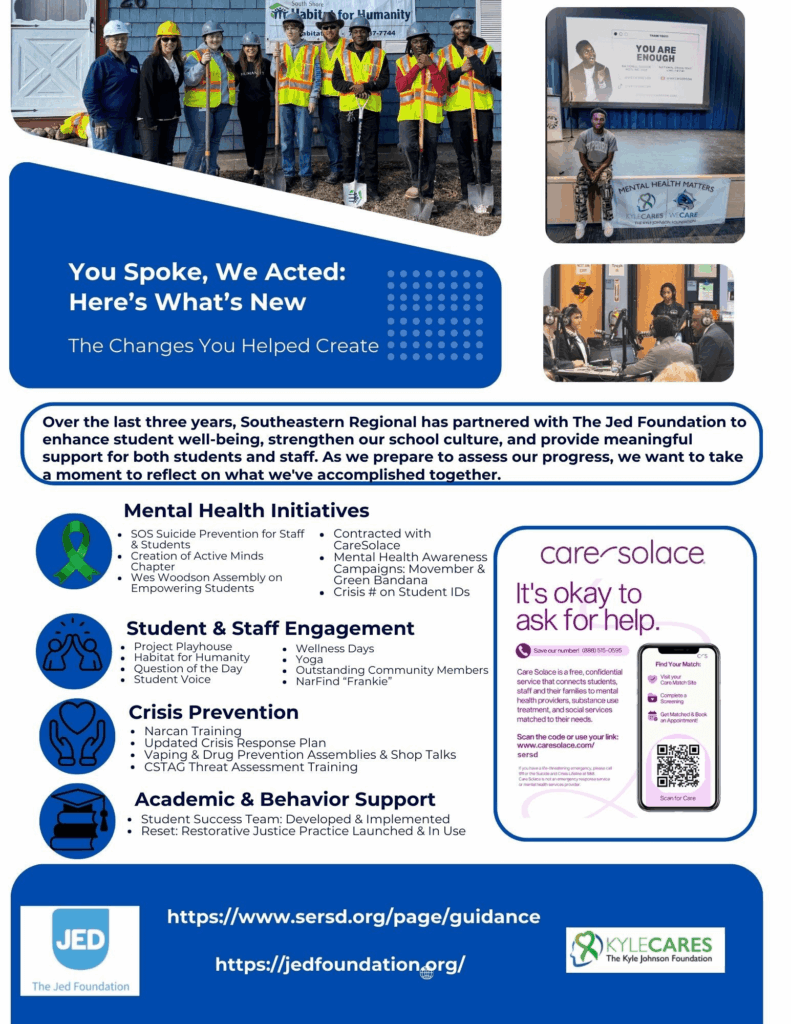
Lois Miller arrived at Southeastern Regional Vocational Technical High School (SRVTHS) in Easton, Massachusetts, in 2024 with classic new-job energy. “When I came to Southeastern, I thought, ‘Oh, we’re going to need to do a survey. I need to see where everything is at’,” said Miller, MS, CAGS, reflecting on her first few weeks as the director of guidance at SRVTHS. 

But, to her surprise, she wouldn’t need to do a survey. SRVTHS was in the second year of the three-year JED High School Program, aiming to strengthen its mental health, substance misuse, and suicide prevention programs and systems. At the start of the partnership, The Jed Foundation (JED) surveyed teachers, students, and staff to identify and understand the current climate, needs, policies, programs, and practices surrounding student mental health.  

Drawing off the survey data, JED worked with a steering committee at the school to develop a strategic plan. The plan outlined how to efficiently and effectively enhance what is already working and address unmet needs. That meant Miller came into her new role with the information she needed, and she said she was delighted to find “this great strategic plan that was already put together with all sorts of resources on not just what to do, but ideas on how to get started.” With that information, Miller was able to focus on enacting the recommendations in the plan.

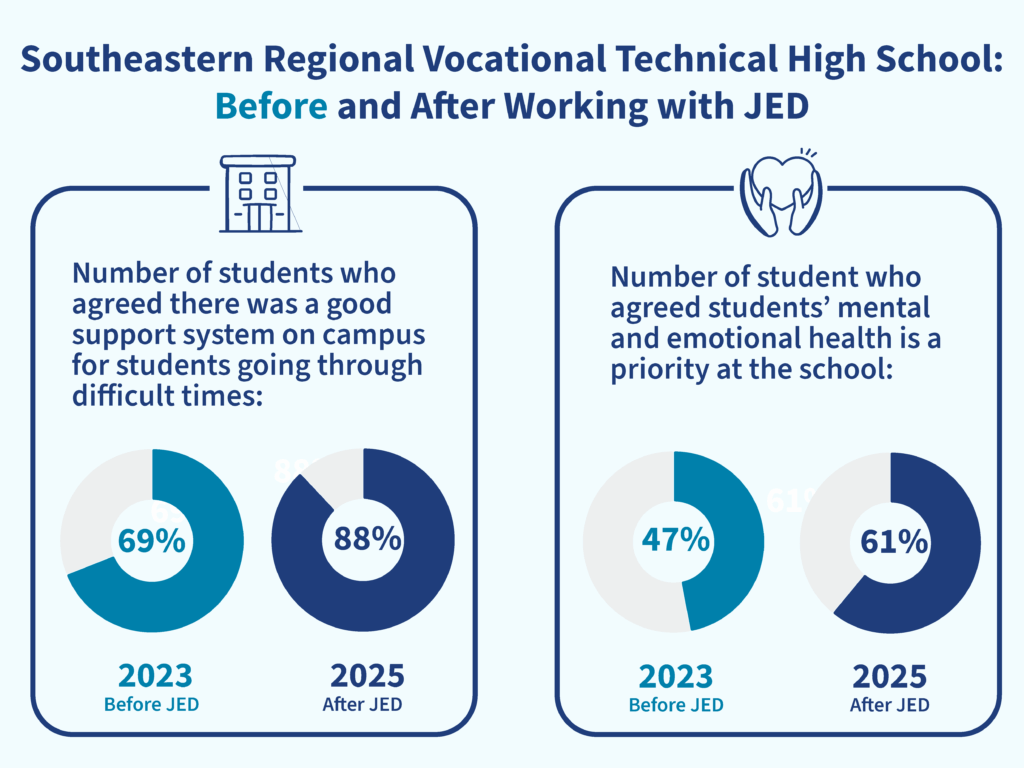
At the end of the three-year engagement, JED distributed another set of surveys to document what the school accomplished, and SRVTHS’ data spoke volumes. In the original survey, 69% of students agreed there was a good support system on campus for students going through difficult times. Now 88% reported feeling that way — a 19% change. There was also a nearly 30% jump in students who agreed that mental and emotional health is a priority at the school: In 2023, 47% said it was a priority, while 61% said so in 2025.

Here’s a glimpse at how the school got there.

Gaining Motivation, Support, and Partnership With JED 

At the very first in-person meeting with JED in 2023, David A. Joseph, a guidance counselor at SRVTHS, recalls reviewing results from the initial survey. “It really set the stage for what we thought JED was going to lead us through,” Joseph says. 

JED reviewed the survey data and used its evidence-based framework — the Comprehensive Approach to Mental Health Promotion and Suicide Prevention for High Schools — to create a plan for SRVTHS. After reviewing the plan and considering the school’s culture and climate, SRVTHS officials chose to focus on three domains: establish and follow crisis-management procedures, encourage help-seeking behavior, and improve recognition of and response to early warning signs of distress. 

“What was great about the start of the process of working with JED was that [their message was], ‘No, don’t try to touch everything all at once’,” Miller says. “You know how it is when you try to do everything at once — nothing gets done the way you want.” 

Instead, Miller found that JED offered empathetic flexibility. The school was partnered with Krystal Skaggs, MS, LPC, LCDC-I, a JED School Mental Health Specialist. With a background as a mental health therapist and school counselor, as well as a long history of working in school settings, Skaggs brought an intrinsic understanding of the day-to-day challenges in public education. Miller and her steering committee met monthly with Skaggs.

“Having the check-ins was exactly what we needed to stay on the course,” Miller says. 

Three Years, and Big Accomplishments 

Here are some of the main accomplishments SRVTHS achieved in its three years working with JED.

Enacting a Suicide Prevention Program 

“One of the big things that we really worked on was suicide prevention,” Miller says. The high school now has a standardized practice in place to respond to students in distress. All counselors and staff members have been trained in the protocol, Miller says. 

The previous year, the school had a Signs of Suicide suicide-prevention training with teachers and freshmen; last year, there was training for both freshmen and sophomores. 

“That was a huge accomplishment,” Miller says. 

Encouraging Help-Seeking Behavior and Access to Care 

To increase help-seeking behavior among students, SRVTHS implemented a program with Care Solace, a service that allows students, staff, and anyone in the school community to access referrals to a wide variety of services outside of what the school provides. That’s often therapy, Miller says, but people can also seek services for neuropsychological evaluations and other mental health support. 

“When people are depressed or struggling, making all those phone calls is really difficult,” Miller says. 

Developing Students’ Life Skills 

There’s no denying that it’s helpful for young people to feel confident in their social skills. To that end, Miller does a question of the day each morning with students and staff. 

“It’s just trying to connect with them…and it really does make an impact,” Miller says. Some questions require deep thought (those are never asked on a Monday), but often they’re simple: What’s a color you associate with July? Have you ever lived in another state? What are your go-to rainy-day activities?

Miller relies on The First Five, a resource Skaggs shared with her, which sends a daily email with questions tailored for various grades. 

Turning a Spotlight on Mental Health 

Over three years, the partnership has allowed the school to put more energy into improving its students’ mental wellness. The work done in the counseling department and the support available are more visible, Joseph says. 

“JED helped make it feel more schoolwide, and not feel like it’s something that just counselors do in the building,” Joseph says of SRVTHS’ mental health supports. 

Students have gotten involved in amplifying mental health care through awareness campaigns such as Movember and Green Bandana, and helping others through organizations such as Habitat for Humanity and Project Playhouse. Many staff members are also involved with programs related to student well-being, Joseph says. The school’s athletic department, for example, ran a program on mental health awareness. 

“It makes a bigger impact if we’re all working together on it,” Miller says. 

Southeastern Regional Vocational Technical High School's partnership with The Jed Foundation (JED)

What’s Ahead for SRVTHS

Joseph hopes more teachers will get involved in various programs, especially those of vocational classes. The teachers, who come with expertise on plumbing, HVAC systems, and other trades, work closely with students, but they may not have experience identifying mental health issues or providing support.  

For Miller and Joseph, there’s a glow from the accomplishments that are reflected in the survey data. “It’s exciting…getting that validation” from the survey, Miller says. “It helps with the motivation to keep moving forward in the right direction.” 

Plus, there’s a clear sense of what remains to be done: Some areas of the strategic plan presented early on in the partnership haven’t yet been addressed. 

“We know where we need to go, and we have a road map to get there,” Miller says. 

Bring JED High School to your community and find out how you can support JED’s lifesaving work.

National & Local Media Coverage of KCTCS and JED Partnership

Find local and national news coverage about the first-ever Mental Health Strategy for the Kentucky Community and Technical College System (KCTCS), which supports the mental well-being of 110,000+ students across all 16 colleges.

  • Yahoo! Finance: The Kentucky Community and Technical College System (KCTCS) Partners with The Jed Foundation (JED) to Launch Mental Health Plan for 110,000 Students
  • Spectrum News: KCTCS Mental Health Partnership with JED 
  • Fox56 WDKY: KCTCS Mental Health Partnership with JED 
  • Eyewitness News WTVW: KCTCS Mental Health Partnership with JED 
  • The Paducah Sun: Kentucky Community and Technical College System launches mental health plan for students
  • Northern Kentucky Tribune: KCTCS, The Jed Foundation partner for new mental health strategy to support student mental health
  • Kentucky Today: KCTCS releases new mental health strategy to support students
  • Community College Daily: Statewide effort prioritizes mental health support for students
  • Kentucky News Network: JED’s Senior Director, Alumni Programs and Engagement, Erica Riba, Speaks on JED and KCTCS Partnership
  • Fox 5 San Diego: The Kentucky Community and Technical College System (KCTCS) Partners with The Jed Foundation (JED) to Launch Mental Health Plan for 110,000 Students

The Kentucky Community and Technical College System (KCTCS) Partners with The Jed Foundation (JED) to Launch Mental Health Plan for 110,000 Students

New framework responds to urgent student needs
and builds momentum for statewide action

[July 22, 2025 VERSAILLES, Ky] — The Kentucky Community and Technical College System (KCTCS) is rolling out its first-ever Mental Health Strategy to support the mental well-being of more than 110,000 students across all 16 colleges. The initiative is backed by partnerships with The Jed Foundation (JED), The Healthy Minds Network, and the Council on Postsecondary Education

This new strategy is the result of JED’s technical-assistance support and consultation.  JED assisted KCTCS in establishing and strengthening a community of care among partner campuses, protecting student mental health, and providing and integrating evidence-based mental health resources, programs, systems, and policies. JED and KCTCS approached the work in a systematic manner across the system and within individual member institutions.

Results from the Healthy Minds Study conducted last year across the 16 schools underscore an urgent need for action:

  • 68% of students show signs of depression
  • 66% report anxiety symptoms
  • Only 27% who screen positive for depression or anxiety  are receiving therapy
  • 86% report financial stress

“Community college students experience the same mental health concerns as their university peers, but are more likely to face financial challenges that lead to food and housing insecurity, or less access to medical care, which can compound the issue,” says KCTCS’ Christopher Hetherington, Ed.D., executive director of strategic enrollment management, who leads the system effort. “It’s hard to do well in class when you’re depressed and worried about money. This strategy is about making sure our policies and practices effectively connect students with available resources. Our goal is to empower our students to navigate life’s challenges, stay on track academically, and prepare for meaningful careers.”

Six key focus areas guide KCTCS’s new plan: survey-informed interventions, faculty and staff training, an early-alert guide, mental health communication campaigns, peer wellness programs, and expanded grant and partner-supported services.

The system strategy also aligns with the Kentucky Council on Postsecondary Education’s statewide mental health plan, ensuring shared priorities and coordinated action across institutions.

KCTCS President Ryan Quarles emphasized the deep connection between student well-being and success.

“In Kentucky, we know that the strength of our communities lies in the well-being of our people,” said Quarles. “When we prioritize mental health, we pave the way for brighter futures, stronger communities, and boundless opportunities. This important work has been made possible thanks to the backing of our state and national partners and the KCTCS community.”

“Community and technical colleges serve a diverse and often nontraditional student body — including working adults, first-generation students, and student parents — all while navigating limited institutional resources,” said Erica Riba, Ed.D., senior director of alumni programs and engagement at JED, who advised on the systemwide mental health strategy. “What stands out across KCTCS is the deep care and commitment from campus professionals. This systemwide strategy reflects JED’s approach: using data, strengthening infrastructure, and helping schools build environments where all students can thrive.”

The new strategy represents a significant milestone in Kentucky’s broader effort to prioritize mental health in higher education and a model for how community colleges nationwide can take action. 

“A statewide effort to collect these data is an essential step toward a public health approach that addresses mental health and well-being. We are thrilled that Healthy Minds data can be used to inform statewide decision-making, guided by evidence around students’ needs, addressing disparities in access to resources, and shaping conditions that allow more students to thrive in college,” said Sarah Lipson, Ph.D, Ed.M, principal investigator of the Healthy Minds Network and associate professor at the Boston University School of Public Health.

The full Strategic Mental Health Framework can be found on our website.   

Media interviews with members of the KCTCS Mental Health Taskforce are available upon request.


About The Kentucky Community and Technical College System (KCTCS)
The Kentucky Community and Technical College System (KCTCS) consists of a network of regional colleges and a system office dedicated to serving communities across the commonwealth. As Kentucky’s largest provider of workforce training and postsecondary education, KCTCS enrolls more than 110,000 students annually. United in mission and purpose, KCTCS and its colleges are committed to improving the lives of students, strengthening communities and advancing the prosperity of Kentucky’s citizens.

About The Healthy Minds Network
The Healthy Minds Network is one of the nation’s premier research organizations contributing to adolescent and young adult mental health. HMN is dedicated to improving the mental and emotional well-being of young people through innovative, multidisciplinary scholarship. HMN spans coast to coast with our principal investigators at the University of California-Los Angeles, the University of Michigan, Wayne State University, and Boston University. Our network proudly serves as a resource for post-secondary education administrators, students, researchers, clinicians, policy-makers, and the greater public.

For 15 years, the network has administered the Healthy Minds Study (HMS), a population-level survey of post-secondary student mental health. Over 935,000 responses from students at more than 675 colleges and universities have been gathered. In the past few years, the network’s research efforts have expanded into other facets of mental health in educational settings, including the role and health of faculty and staff.

About The Jed Foundation
JED is a nonprofit that protects emotional health and prevents suicide for our nation’s teens and young adults. We’re partnering with high schools, colleges, and school districts to strengthen their mental health, substance misuse, and suicide prevention programs and systems. We’re equipping teens and young adults with the skills and knowledge to help themselves and each other. We’re encouraging community awareness, understanding, and action for young adult mental health.

Connect with JED: Email | LinkedIn | Instagram | Facebook | TikTok | Snapchat | YouTube 

Media Contacts

KCTCS Media Contact
Sue Patrick
859-333-3177
sue.patrick@kctcs.edu

Justin Barbo
Director of Public Relations
The Jed Foundation
914-844-4611
justin@jedfoundation.org


JED Launches New Programming to Strengthen Mental Health Support in Fraternities and Sororities

Initiative offers expert support, evidence-informed guidance to promote young adult emotional health and prevent suicide.

young people sitting on the beach talking

[July 17, 2025, New York City] — Fraternities and sororities shape the college experience for hundreds of thousands of students, and they can have a powerful impact on the emotional well-being of their members and the broader campus community. Today, The Jed Foundation (JED) announced the launch of new programming to partner with Greek-letter organizations to help them transform member mental health.

Drawing on two decades of expertise and a proven comprehensive approach, The JED Greek-Letter Organizations programs provide tailored, evidence-informed guidance to fraternities and sororities committed to promoting emotional well-being and preventing suicide through a two-year technical assistance program or customized consulting. Over the course of the two-year program, JED partners with participating organizations to:

  • Assess organizational needs and priorities
  • Review, improve, or create policies and procedures
  • Enhance substance misuse prevention through a JED-led, customized workshop, developed in partnership with Partnership to End Addiction
  • Strengthen hazing prevention via a JED-led workshop, developed in partnership with the  Timothy J. Piazza Center for Fraternity and Sorority Research
  • Train staff, volunteers, alumni, and members using JED-developed workshops that meet their needs, including “You Can Help a Member” and “It’s OK to Say Suicide.”
  • Support implementation tools, strategies, and techniques for measurable youth mental health improvements
  • Evaluate progress and develop sustainability plans

Through customized consulting, JED partners with organizations to:

  • Review or co-develop policies that strengthen and protect the emotional health of members and students who socialize with fraternal organizations, including crisis intervention, substance misuse and amnesty policies, bullying and cyberbullying, hazing, and sexual assault
  • Provide workshops and trainings to address the identified needs of the organization
  • Hold one-on-one coaching calls to problem-solve priority issues identities by the organization.

Sigma Phi Epsilon Fraternity (SigEp), with more than 12,000 undergraduates on 200 campuses, is among the first college fraternities to join this new program. Its mission is Building Balanced Men, achieved through a continuous member development program focused on personal and leadership development in a substance-free environment.

“JED’s approach to supporting mental well-being in fraternity and sorority communities will ensure SigEp’s policies and core experiences continue to be at the forefront in the prevention of suicide, hazing, and substance misuse,” said Brian Warren, CEO of Sigma Phi Epsilon Fraternity. “The partnership will enhance our Balanced Men Program, which supports several dimensions of wellness, by helping our members understand themselves, seek balance, build strong relationships, and pursue excellence in their lives. Recommended by SigEp’s Mental Health Committee based on JED’s proven expertise, this partnership was a natural next step as we evaluate and enhance our experience for undergraduates and volunteers.”

The JED Greek-Letter Organizations programs build on JED’s recent report, Fraternities and Mental Health: Supporting Emotional Well-Being Among Members and Across Campus, which highlights both the potential positives and the risks of Greek life. The findings, coupled with JED’s experience in this area, yielded several key recommendations and themes to enhance the emotional well-being of both fraternity members and other students on campus. While fraternities can provide belonging and social connection — protective factors for mental health — they also present significant risks, including substance misuse and sexual misconduct, that impact both members and the broader campus community, highlighting the need for increased awareness and positive response strategies.

“There are more than 1,500 Greek-letter organizations at colleges and universities across the United States, serving approximately 750,000 undergraduate students. These communities have enormous potential to foster connection, resilience, and support,” said Dr. Katie Hurley, JED’s Senior Director of Clinical Advising and Community Programming. “JED’s new program meets fraternities and sororities where they are, helping them build systems of support that are grounded in research, responsive to their unique needs and cultures, and designed to enhance safety and well-being for their members and broader campus communities.”

The program is rooted in JED’s comprehensive approach, a proven model used across more than 530 colleges and universities nationwide. JED’s recent report, A Decade of Improving College Mental Health Systems: JED Campus Impact Report, analyzed a decade of data (2013 to 2023) from JED Campus schools and the Healthy Minds Network survey. Schools that completed JED Campus saw statistically significant improvements in student mental health at the end of the program. Students were:

  • 25% less likely to report a suicide attempt 
  • 13% less likely to report suicide planning
  • 10% less likely to report suicidal ideation

Students also had improved average anxiety and depression scores, and were more likely to stay in school and graduate.

Fees for The JED Greek-Letter Organizations programs vary depending on organizational needs and scope. Sliding-scale options and grant support may be available.

For more information, contact greek@jedfoundation.org.


About The Jed Foundation (JED)
JED is a nonprofit that protects emotional health and prevents suicide for our nation’s teens and young adults. We’re partnering with high schools, colleges, and school districts to strengthen their mental health, substance misuse, and suicide prevention programs and systems. We’re equipping teens and young adults with the skills and knowledge to help themselves and each other. We’re encouraging community awareness, understanding, and action for young adult mental health. 

Connect with JED: Email | LinkedIn | Instagram | Facebook | TikTok | Snapchat | YouTube 

Media Contact

Justin Barbo
Director of Public Relations
The Jed Foundation
914-844-4611
justin@jedfoundation.org

Building Stronger Communities: Kentucky’s Mental Health Convening Sparks Statewide Action

Kentucky Student Success Collaborative Mental Health ConveningKentucky Student Success Collaborative Mental Health Convening

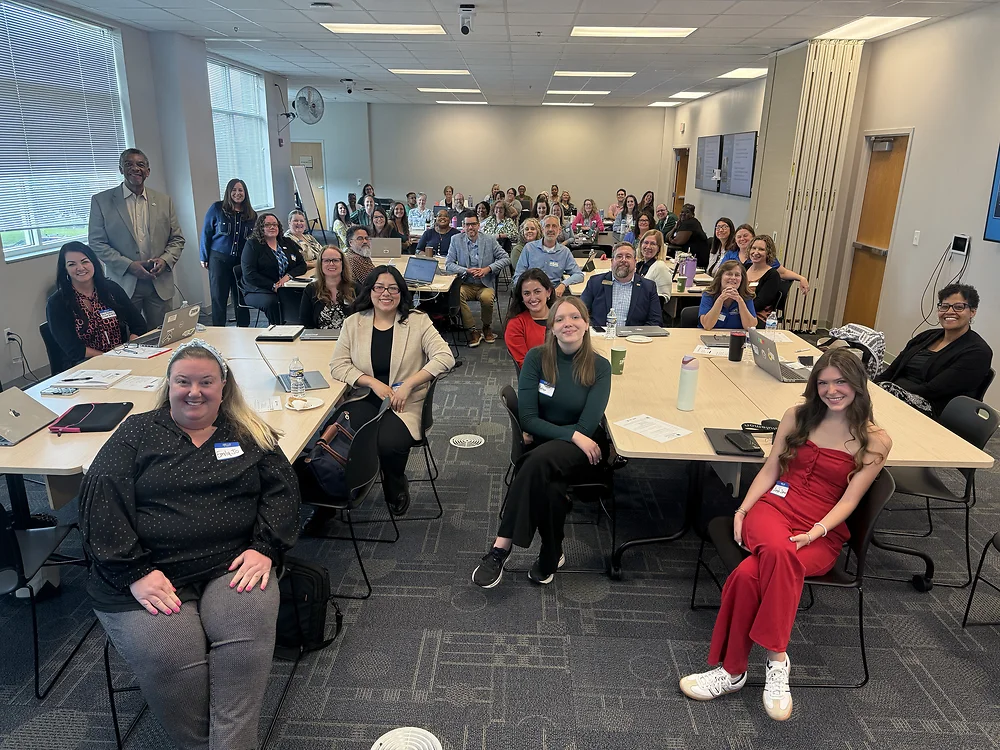
The Jed Foundation (JED) has a unique position working with state systems across the country that creates powerful opportunities to connect leaders and share proven strategies that drive impact. On May 19, the Kentucky Council on Postsecondary Education and dedicated professionals from across the Bluegrass State came together for the Kentucky Student Success Collaborative Mental Health Convening. JED was honored to co-create the gathering as part of our ongoing partnership to bolster support for student mental health in Kentucky. The convening marked the launch of Kentucky’s statewide plan into action. 

Learning From Another State

Knowing that state systems have a wealth of knowledge to share with one another, JED introduced attendees to higher education leaders in Utah, who recently completed JED Campus as a statewide cohort. Katie Mazzie, assistant commissioner for strategic and government affairs at the Utah System of Higher Education, served as the keynote speaker for the convening. She offered the system’s experiences as a way to guide Kentucky’s mental health strategy forward.

Mazzie began by sharing a troubling but familiar pattern from her research. In the late 2010s and early 2020s, students were experiencing high levels of anxiety, loneliness, isolation from campus life, financial stress, suicidal ideation, and self-harm attempts. Kentucky shared those concerns about their students. 

Mazzie highlighted four statewide initiatives Utah launched to address the stressors students were facing:

Trula: A peer-support program that offers in-person and virtual coaching to help students develop academic and life skills during their college transition. Of the more than 6,300 students served, 86% reported feeling better equipped to balance college demands and face challenges with confidence after completing the program.

SafeUT: A 24/7 crisis chat and tip line launched in 2015 that provides around-the-clock access to licensed counselors and crisis workers. In 2023 alone, SafeUT facilitated 536 lifesaving interventions and provided over 26,000 chats with more than 900,000 messages in 2024.

Campus counseling: Nine out of Utah’s 16 public institutions of higher education now provide on-campus counseling services, making support more accessible where students live and learn.

After-hours programs: Institutions like the University of Utah extended support beyond traditional hours, offering crisis interventions, group therapy sessions, and drop-in hours in residence halls.

Beyond sharing these successful programs, Mazzie offered lessons learned from Utah’s work. The first lesson proved especially relevant for Kentucky’s planning process: the importance of making a compelling argument for why mental health is within higher education’s purview. The responsibilities for higher education are clearly defined by state statute, but Mazzie relies on data that shows mental health challenges are one of the main issues that prevent students from successfully completing their degrees.

Dr. Aaron Thompson, president of Kentucky Council on Postsecondary Education, echoed that sentiment. “Mental health is not just an individual concern,” he said. “It is a collective responsibility that significantly influences academic performance, retention rates, and overall campus well-being. The conversation has to be louder. We must continue to prioritize mental health initiatives and foster a culture of support and understanding across all levels of our institutions, so every individual can have the opportunity to thrive.”

Moving Into Action in Kentucky

Inspired by Utah’s lessons, Kentucky attendees then shifted from learning to planning. They had opportunities to network, hear from a student panel, and learn about Kentucky Community and Technical College System’s strategic visions for student mental health. 

Participants from across the state informed the creation of a new guiding team, which will steer the statewide implementation of their mental health strategy. The team includes representatives from public and private institutions, as well as from the Kentucky Community and Technical College System. 

The team’s collaborative leadership will ensure that the strategy reflects diverse institutional perspectives and meets the needs of students across Kentucky. JED will also provide guidance and support during implementation, which will focus on the four priority areas: centering student voices, training faculty and staff, enhancing resources to respond to crises, and improving campus communication about mental health supports.

“Together we focused on equipping campuses, supporting students, and identifying innovative ways to move us forward,” said Dr. Erica Riba, JED’s Senior Director of Alumni Programs and Engagement, who has served as an adviser on the multiyear project. “With this momentum, we’re now shifting to implementation, turning our shared goals into coordinated action across Kentucky’s colleges and universities.”

To learn more about how JED supports state-level systems, email JedCampusInfo@jedfoundation.org.

JED and the Red Sox Foundation Unite to Support Student Mental Health

Students open mental health wellness kits

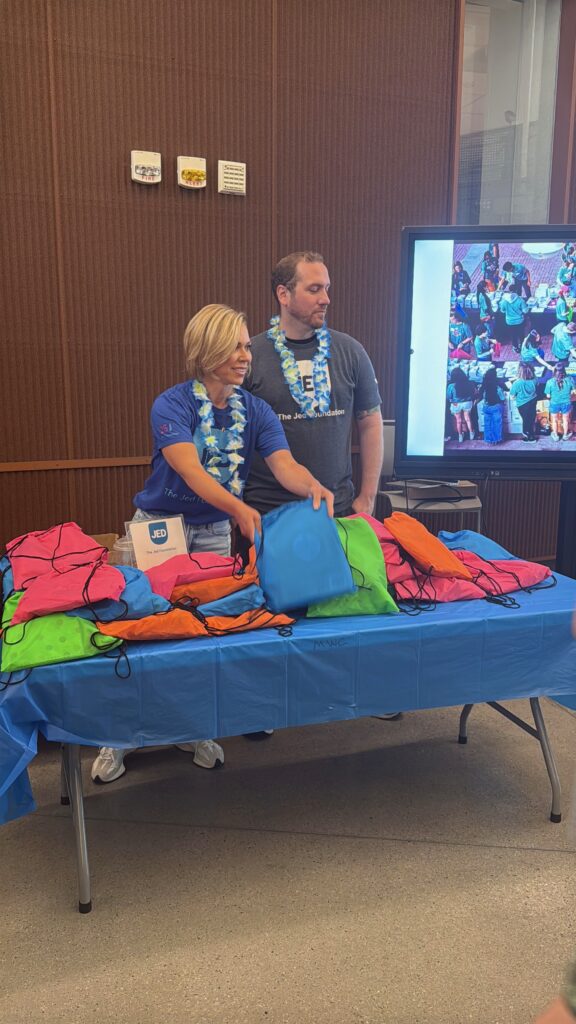
The Jed Foundation (JED) joined forces with the Red Sox Foundation and its New England Service Scholarship recipients at Fenway Park on June 27 to pack 2,000 mental health wellness kits for high school students across Massachusetts. 

JED helped the Red Sox Foundation identify schools that would benefit from the kits, and on July 8, JED staff members distributed them to Weymouth High School, North Attleboro High School, and Attleboro High School — three participants in the JED High School program.

The kits included items such as fidget rings, journals, mindfulness or affirmation cards, and ear plugs — tools and resources specifically chosen to help students navigate stress, build resilience, and prioritize their mental wellness. Some even included handwritten notes from the students who put them together. The Red Sox Foundation chose to make the care packages as the community service project for its scholarship recipients.

JED staffers hand out mental wellness kits

“Schools are often stretched thin when it comes to funding, so receiving something at no cost — and in such generous quantity — was genuinely exciting for them,” says Krystal Skaggs, MS, LPC, a school mental health specialist at JED.

When students receive the care packages when they return to school in the fall, they’re getting more than just helpful items. They’re receiving a message that their mental health matters, that their community is invested in their success, and that seeking support is a sign of strength, not weakness.

Students wearing backpacks

Learn more about JED’s work with high schools.

Two 2024 Youth Advocacy Coalition Interns Look Back on the Program

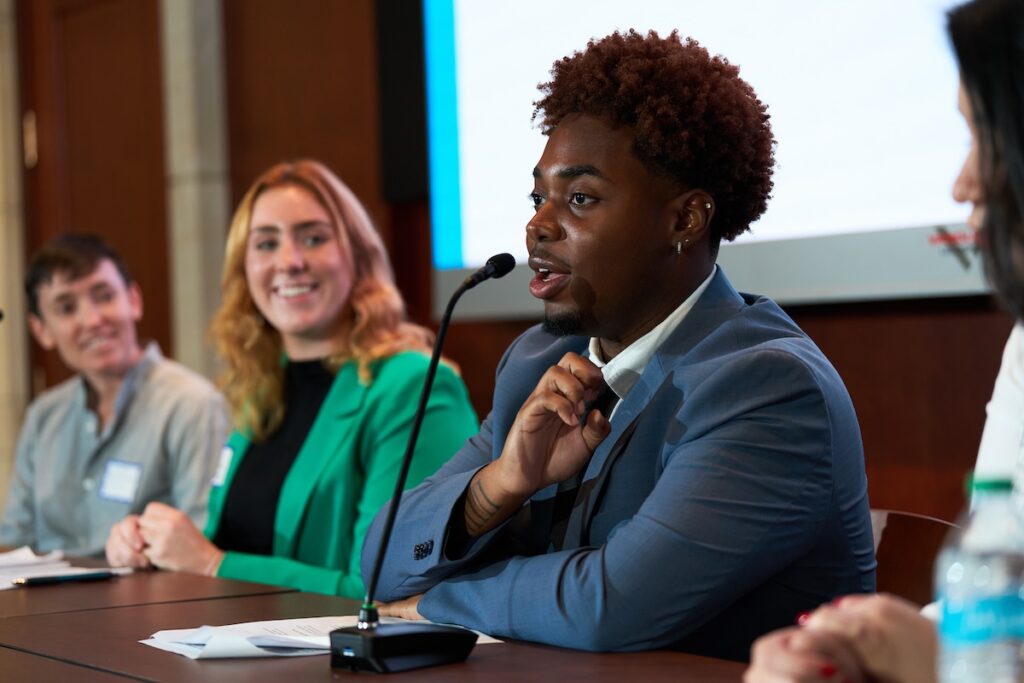
Young man in blue suit sitting at a desk speaking into a microphone while panelists look on.

Jaden Brown and Hannah Corwin were among the inaugural participants in The Jed Foundation’s (JED) National Mental Health Youth Advocacy Coalition (YAC) internship program. This 10-week paid program trained undergraduates in mental health advocacy and community outreach through a structured curriculum and expert mentorship to help them engage in mental health advocacy at the community, state, and federal levels. 

At the end of their internship, Brown and Corwin presented their work before various audiences and Brown spoke on a youth panel at JED’s annual Policy Summit in Washington, D.C, last October. JED is currently recruiting for the next cohort of YAC interns.

We asked Brown and Corwin about their experiences as YAC interns and what the program meant to them. 

What were your main accomplishments as a YAC intern?

Brown: My biggest accomplishment as a YAC intern was being able to be vulnerable and transparent about my mental health journey. I believe that I was able to effectively advocate for millions of youth nationwide, emphasizing the importance of mental health resources and support systems.

Corwin: I would say my main accomplishments include contributing to active and impactful advocacy work amidst so much national change. It was empowering to do research and have important conversations with the people who are shaping the future of our country’s culture surrounding mental health. 

What is your favorite memory or most impactful moment of the experience?

Corwin: Because my internship was virtual, it was super impactful to attend the most recent conference in Baltimore. Being able to meet many of the people I’d been working with was so great, and it was also amazing to see and hear from a group of like-minded, smart, and dedicated people with a shared cause. 

Brown: My most impactful moment from the experience was being able to be in conversation with mental health professionals and fellow advocates about the direction in which mental health for many youth is headed and constructing effective means to combat the challenges that these youth face during one of the most trivial periods in history.

What are your key takeaways or lessons learned? How will these help you in your future career?

Corwin: I learned the importance of collaborating with people both similar and different to yourself. There is much to be learned from those who have a similar background and career to you, but it is also just as important to be introduced to new perspectives and ideas. 

Why should others consider applying to the program? Any advice for future YAC interns?

Brown: As a YAC intern, you will meet a myriad of mental health professionals and advocates that will enlighten you in ways you would never have imagined. The connections and memories that are made during your time as a fellow are invaluable. I encourage anyone and everyone who comes across the application to apply because even if you doubt yourself or aren’t sure where to get started with being involved, everyone has a story that the world is willing to listen to.

The deadline to apply for the Summer 2025 cohort is Friday,Jul 11, 2025 at 6 p.m. ET. Learn more about the program on the YAC application page.


The Jed Foundation Condemns Final Passage of the “One Big Beautiful Bill Act” as a Grave Setback for Youth Mental Health

Lawmakers Chose $1 Trillion in Medicaid Cuts, 12 Million People Projected to Lose Health Coverage

New York, NY — The Jed Foundation (JED) today expresses deep alarm and concern at the final passage of H.R.1, the “One Big Beautiful Bill Act,” which now heads to the President’s desk for signature. The legislation includes nearly $1 trillion in cuts to Medicaid, the nation’s largest provider of mental health services, posing an unprecedented threat to the health and well-being of children, teens, and young adults across the country. 

“This legislation is a devastating blow for millions of Americans, revoking their access to mental health care across the country,” said Dr. Zainab Okolo, Senior Vice President of Policy, Advocacy, and Government Relations at JED. “With this vote, Congress has undermined a system that millions of children and their families rely on for mental health care. The cost will be measured in rising crises, deepening despair, and lives we could have saved.” 

Medicaid is a lifeline for American families, currently providing health care coverage for nearly half of all U.S. children. These cuts mean more children and young adults in crisis because there will be fewer places to turn for healthcare, and fewer youth and families able to afford the help they need. 

Key consequences of H.R.1 include: 

  • Widespread loss of health coverage: The Congressional Budget Office estimates that up to 12 million people will lose Medicaid coverage. 
    • Decreased funding for hospitals and care providers: H.R.1 restricts how states can fund their Medicaid programs, weakening safety-net hospitals and reducing the availability of care for low-income and underserved communities. 
    • Reduction in the future medical and mental health workforce: This bill eliminates key student loan repayment plans (SAVE, PAYE, ICR), eliminates the Graduate PLUS program, and caps the Parent PLUS loan, leaving potential future doctors, nurses, and other healthcare providers with limited options for financing their higher education. The changes will increase monthly payments and make forgiveness harder to access, discouraging entry into essential and already shorthanded fields like mental health, primary care, and social work. 
    • School-based services at risk: The loss in state Medicaid revenue may force schools to cut counselors, cancel programs, and refer students to already overburdened emergency rooms. This will undo much of the progress made since the passage of the 2022 Bipartisan Safer Communities Act, which helped fund on-site mental health services for schools. 
  • The already underserved will be particularly impacted: The negative effects of this bill won’t be felt equally. Children in rural or low-income areas, those in foster care, and LGBTQ+ youth often rely heavily on Medicaid for mental health support. In many rural communities, school-based services are the only mental health care available. Losing these services would make it much harder for young people to get the help they need when they need it most.
  • Worsening health outcomes that impact youth mental health: Mental health and physical health are intrinsically linked. With approximately 40% of children having a chronic health condition, access to Medicaid for annual physicals, preventive care, screenings, diagnosis, and treatment is essential not only to prevent more serious illness but to support their emotional well-being.      

Medicaid has long represented a shared national value to provide healthcare coverage to vulnerable people and families who might otherwise be unable to afford it, including children, pregnant women, the elderly, and people with disabilities. 

The recent, rapid decisions by Congress and the Administration — whether advancing harmful legislation like H.R.1 or withholding $7 billion in congressionally appropriated funding for K–12 schools — send a troubling message. Together, these actions threaten to strip children of critical health coverage, school-based supports, after-school programs, and essential access points to mental health care.

“It is painful to see this existing, life-saving system weakened in a way that will result in millions of Americans, including children, losing their preventative and medical care,” said JED CEO John MacPhee. “We are deeply worried about the impact on the well-being and mental health of the youth we serve.” 

The Jed Foundation urges states to do everything in their power to blunt the impact of these federal actions. State leaders must safeguard the programs and supports that children, families, and young people depend on, especially those in rural communities and other underserved populations. Now more than ever, our children need leaders who will choose care over cuts and prioritize their well-being over politics.

At JED, we are deepening our commitment to partnering with states, school systems, and providers to help them mitigate the harms of the new law and protect access to mental health services across communities, schools, and youth-serving programs. With federal resources cut, all those who care about youth mental health must come together to do everything in our power to safeguard the safety net that protects our nation’s young people.

###

About The Jed Foundation (JED)
JED is a nonprofit that protects emotional health and prevents suicide for our nation’s teens and young adults. We’re partnering with high schools, colleges, and school districts to strengthen their mental health, substance misuse, and suicide prevention programs and systems. We’re equipping teens and young adults with the skills and knowledge to help themselves and each other. We’re encouraging community awareness, understanding, and action for young adult mental health. 

Connect with JED: Email | LinkedIn | Instagram | Facebook | TikTok | Snapchat | YouTube 

Media Contact

Justin Barbo
Director of Public Relations
The Jed Foundation
914-844-4611
justin@jedfoundation.org

The Jed Foundation Warns of Devastating Youth Mental Health Impact as Senate Advances “One Big Beautiful Bill”

Urges Lawmakers to Reject nearly $1 Trillion in Medicaid Cuts 

New York, NY — The Jed Foundation (JED) today issued a stark warning following the Senate passage of H.R. 1, the “One Big Beautiful Bill Act,” a reconciliation package that includes nearly $1 trillion in cuts to Medicaid and other vital youth mental health supports. As the bill heads toward a final vote in the House, JED is urging Congress to protect Medicaid and Children’s Health Insurance Program (CHIP) access for children, teens, and young adults, warning that the proposed changes pose a direct threat to the safety and well-being of our nation’s youth. 

“Medicaid is the single largest payer of mental health care in this country,” said Dr. Zainab Okolo, Senior Vice President of Policy, Advocacy, and Government Relations at The Jed Foundation. “We cannot meaningfully address youth mental health while cutting off access to the very system that delivers care. These changes would roll back hard-won bipartisan progress, jeopardizing school-based services, shrinking provider networks, and disenrolling millions of families not because they’re ineligible, but because of funding cuts and new bureaucratic barriers. It’s a step backward that will place millions of youth and their families at risk nationwide.”

The result will be more children and young adults in crisis because there will be fewer places to turn for health care, and fewer youth and families able to afford the help they need. Medicaid is a lifeline for American families, currently providing health care coverage for nearly half of all U.S. children.

The consequences for youth mental health will be severe: 

  • Millions will lose their Medicaid coverage: States would be required to implement new eligibility verification systems and community engagement requirements. The burden will fall on parents to complete Medicaid eligibility and verification paperwork every six months for themselves and their children. The Congressional Budget Office estimates that these provisions would result in 12 million people losing coverage, many due to paperwork barriers rather than changes in eligibility. JED is particularly concerned that low-income youth, including the 40% of rural children and 38% of urban children covered by Medicaid, will lose vital access to mental health services.
    • Hospitals will suffer: H.R. 1 significantly decreases the revenue states can collect for Medicaid through taxation of healthcare providers. While H.R. 1 includes a $50 billion fund for rural hospitals, this only addresses part of the shortfall, as the majority of hospitals will struggle to absorb the costs. 
    • School-based services will be at risk: The loss in state Medicaid revenue may force schools to cut counselors, cancel programs, and refer students to already overburdened emergency rooms. This will undo much of the progress made since the passage of the 2022 Bipartisan Safer Communities Act, which helped fund on-site mental health services for schools. 
  • The already underserved will be particularly impacted: The negative effects of this bill won’t be felt equally. Children in rural or low-income areas, those in foster care, and LGBTQ+ young adults often rely heavily on Medicaid for mental health support. For rural communities, in particular, school-based services may be the only mental health care available. Losing these services would make it much harder for young people to get the help they need when they need it most.
  • Worsening health outcomes will impact youth mental health: Mental health and physical health are intrinsically linked. At a time when roughly 40% of children have a chronic health condition, access to Medicaid for annual physicals, preventive care, screenings, diagnosis, and treatment is essential to protecting children’s health and preventing more serious illness. Supporting youth in managing their conditions also supports their emotional well-being.      

JED calls on lawmakers to uphold the bipartisan commitment to youth mental health made in recent years and remove harmful Medicaid restrictions from the final version of the bill. JED will continue to provide programming and advocate for policies that ensure access to care, reduce suicide risk, and equip youth and families with the tools they need to thrive.

##

About The Jed Foundation (JED)
JED is a nonprofit that protects emotional health and prevents suicide for our nation’s teens and young adults. We’re partnering with high schools, colleges, and school districts to strengthen their mental health, substance misuse, and suicide prevention programs and systems. We’re equipping teens and young adults with the skills and knowledge to help themselves and each other. We’re encouraging community awareness, understanding, and action for young adult mental health. 

Connect with JED: Email | LinkedIn | Instagram | Facebook | TikTok | Snapchat | YouTube 

Media Contact
Justin Barbo
Director of Public Relations, The Jed Foundation
Justin@jedfoundation.org

Get Help Now

If you or someone you know needs to talk to someone right now, text, call, or chat 988 for a free confidential conversation with a trained counselor 24/7. 

You can also contact the Crisis Text Line by texting HOME to 741-741.

If this is a medical emergency or if there is immediate danger of harm, call 911 and explain that you need support for a mental health crisis.