Page 31 | The Jed Foundation

Meet the “Glow Getters:” The Students Who Helped Launch Neon Nights

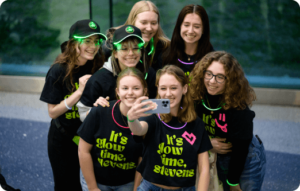
Group of smiling students taking a selfie wearing black tshirts that. say its glow time stevens

By Lauren Patetta 

Before the launch of Neon Nights, the student organizers at Stevens Institute of Technology were already well acquainted with mental health advocacy. Between the impact of COVID-19, their peers’ experiences, and their own personal struggles, mental health has played a prominent role in their lives. 

“When I heard about the opportunity [to get involved in Neon Nights], I really just wanted to give back,” said Sydney Linford, the Sponsorship Chair of the Neon Nights planning committee and a fourth-year student at Stevens. “Mental health has kind of been an ongoing journey throughout my high school and now college life.”  

Last March, The Jed Foundation (JED) held its inaugural Neon Nights event at Stevens, which is located in Hoboken, New Jersey. The signature student-led event raises both awareness of mental health and funds for JED so it can advance its mission to protect emotional health and prevent suicide among young people. 

“When I first started my journey at Stevens, I had immense anxiety and I was having a really hard time,” said volunteer Alicia Zajac. “The main reason I was involved with Neon Nights is because I’m very passionate about mental health and particularly raising awareness for it on college campuses. I think a lot of times it can fall through the cracks.” 

The pilot event raised $13,000 for mental health, and featured close to 100 students at the signature parade and glow-themed dance party on campus. None of it would have been possible without the incredible support of the student volunteers, whose passion and dedication made Neon Nights a success. 

Jenna Giesecke, a fourth-year student, was Executive Director of the Neon Nights student committee at Stevens. Using her connections with the Greek Honor Society and the Diversity and Inclusion Committee, where she also volunteers as the Accessibility Advocate, Jenna helped to recruit volunteers, host planning meetings, find local sponsors, and advertise the event. She said she didn’t set out with the intention of leading Neon Nights, but fell into the role naturally through her other work on campus.

“I do a lot of work helping students with disabilities and improving accessibility on campus,” Giesecke said. “I thought an event [like Neon Nights] that was geared toward mental health awareness would suit me.” 

Giesecke, who also works as an emergency medical technician in Hoboken, said her EMT training helped shape how she responds to peers who come to her struggling with their mental health and inspired her work with Neon Nights. 

“It’s a very common emergency call for someone to potentially be suicidal or in high distress. … What they tell you [in EMT training] is to just listen and empathize with them,” she said. “I take that to every aspect of my life, whether I’m on a scene or just with my friends. I don’t have to be an expert on mental health. I just need to be there to listen.” 

For Zajac, a junior who volunteered as the Logistics Chair, getting involved with Neon Nights felt like a natural extension of her role as a peer leader. After her tumultuous first year, she became a peer leader to support first-year students as they transition to college life. When she was struggling, the school’s counseling services and older students offered support and became a crucial guide through the uncertainty. She now works to be that resource for other students.

“I really wanted to raise awareness for [mental health on college campuses] and put it on everybody’s radar, and also just host a fun event to destigmatize the conversation surrounding mental health,” Zajac said. “Oftentimes, I think people can perceive it to be a dark or negative thing, and we wanted to bring a new light to it.” 

The organizers said the night of the event and dance party was hectic, exciting, and fulfilling all at once. After months of preparation—and a delay due to a water-main break in Hoboken—the student organizers, volunteers, and participants all finally gathered to “glow” for mental health. Decked out in neon face paint and glow-stick jewelry, students began the event by sharing personal stories related to mental health, including Linford, who gave the opening address. Although it was a bit scary to share her private story in front of a large crowd, she said, it was also very rewarding. 

“My favorite part about the night was seeing so many different organizations and groups of students coming together in one community with one goal,” Zajac said. “Seeing everyone together in one room was, like, oh, my gosh, we’re all here for each other and we all care about one another.”

If you’re interested in getting your campus glowing for mental health, please fill out this form to become a Neon Nights Partner Campus.
 

Supporting High School Students’ Mental Health and Wellbeing with The Jed Foundation

Rachel Butler, Branching Minds

Branching Minds is excited to partner with The Jed Foundation (JED) to bring essential resources to high school classrooms through the Branching Minds Support Library. Informed by direct research with high school students about what they need as they graduate, these new support cards offer concrete tips, tools, and resources on a comprehensive range of topics to help students manage the transition out of high school. Carefully curated and evidence-based, these resources provide teachers and students with accessible and actionable advice to aid in this critical, exciting, and challenging transition. 

All educators understand that this is a critical time to support student mental health, but here are just a few of the statistics that compelled Branching Minds to partner with The Jed Foundation (JED) to provide resources to high school students to help them prioritize their emotional well-being and get the help they need and deserve. 

  • In 2021, more than 40% of high school students said they experienced persistent feelings of sadness and hopelessness. 
  • 22% of high school students reported having serious thoughts of suicide in the past year (CDC, 2022). 
  • 27.6% of college students have a positive suicidal screening (ACHA-NCHA, Spring 2022).
  • Suicide is the second leading cause of death among young people ages 10 to 34.

JED is committed to lowering these numbers. 

Introducing The JED Support Cards

JED has identified areas critical to helping teens and young adults manage their mental health, including:

  • The ability to build healthy and meaningful relationships with others.
  • Understanding and acceptance of those who may be different from themselves.
  • Empathy for others and the ability to think critically about a situation.
  • Being able to communicate their wants and needs, especially in a crisis.
  • Perseverance, willingness to face challenges, and openness to constructive feedback.

Based on these identified skill areas, JED and Branching Minds collaborated to develop interventions geared toward high school students. The resources were designed intentionally for secondary teachers to include opportunities for the students to practice skills in a variety of settings and methods. The interventions are adaptable and enable educators to decide how and when to use the provided resources or elect to leave out or adjust portions in order to meet their students’ needs. 

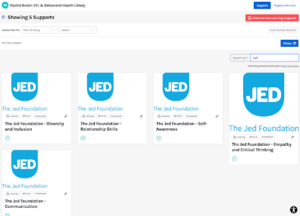
graphic of JED 5 Supports

It is recommended that teachers work through the JED lessons with the whole class, but they can also be used with smaller groups of students who need additional support. While working in these groups, teachers can provide more explicit instruction, encouragement, specific feedback, positive reinforcement, and careful scaffolding. 

These resources can be further leveraged through the inclusion of school guidance counselors, making use of all possible activities in the cards, and inviting students to explore topics more deeply through JED’s Mental Health Resource Center, which includes a section devoted to managing life transitions. 

It is our hope that these resources will offer much-needed support to your students, foster critical conversations about emotional well-being and life transitions, create community around the shared experience of entering young adulthood, and inspire students to make the choices and find the resources that will best support the future they want.

Megan Thee Stallion Says “Check In On Your Friends” in New PSA with Seize the Awkward

Grammy Award-Winning Artist & Philanthropist Joins the National Campaign Encouraging Young Adults to Reach Out to Each Other

NEW YORK, NY (September 26, 2023) – Seize the Awkward, a national campaign that inspires and prepares young adults (ages 16-24) to talk about mental health with their friends, spotlights three-time Grammy-winning superstar, entrepreneur and philanthropist Megan Thee Stallion in a new public service advertisement (PSA), “Check In On Your Friends,” which launched today.

In the latest PSA from the award-winning campaign from the American Foundation for Suicide Prevention (AFSP) and The Jed Foundation (JED) in collaboration with the Ad Council and Droga5, Megan gets real about the pressures to be strong and the importance of peer-to-peer support, reminding viewers that “It’s OK to not be OK.”

“I’m proud to team up with Seize the Awkward and use my platform to help normalize conversations around mental health,” Megan said. “It’s important that we regularly check in on our friends and family and make sure to show empathy, encouragement, and love when they’re struggling. A strong support system can make a powerful difference in someone’s life.”

Data shows that 76% of young adults will turn to a peer for support in a time of crisis, a statistic that inspires the mission of Seize the Awkward. The goal of the campaign is to equip young adults, especially Black and Hispanic youth, with accessible and useful resources for starting conversations around mental health with friends and spotting the signs that a peer may be struggling. In addition to promoting SeizeTheAwkward.org, the PSA also highlights BadBitchesHaveBadDaysToo.com, Megan’s website that offers a wide array of mental health resources.

Seize the Awkward’s latest PSA, “Check In On Your Friends,” was developed pro bono by award-winning creative agency Droga5, part of Accenture Song, and directed by Ewurakua Dawson-Amoah with Greenpoint Pictures. By reflecting Megan’s personal experience with feeling the need to showcase a tough exterior, the film encourages viewers to find strength in vulnerability and open up that conversation with friends.

“We know that social connections and feelings of belonging can reduce stress, anxiety, depression, and loneliness,” said JED CEO John MacPhee. “Partnering with Megan Thee Stallion for our latest Seize the Awkward initiative lets young people know that they don’t have to be strong all the time or suffer in silence. They can reach out to friends in the community for support and care when faced with mental health challenges. Celebrating and advocating for one another not only supports well-being, but protects emotional health and prevents suicide for teens and young adults across America.”

“As we work to address the mental health needs of marginalized youth, our partnership with Megan Thee Stallion will help connect our Seize the Awkward campaign in a more relatable way to a younger and diverse population,” said AFSP CEO Bob Gebbia. “Her involvement will help ensure young people hear the message that struggling with one’s mental health is normal, and so is asking for help. We are grateful to Megan Thee Stallion for being open about her struggles and for normalizing mental health conversations.”

The PSA will appear nationwide across broadcast, digital, social, out-of-home and print formats, including donated media support from Snap Inc., SXM Media and TikTok, among others. Forthcoming audio assets will also be produced by SXM Media’s Studio Resonate. Additionally, a #SeizeTheAwkward influencer activation in partnership with Black-owned influencer agency Kensington Grey will feature Ava Teteh-Ocloo (@ava_tocloo), Charisma Stevens (@charismaticblackgal), Whitney Madueke (@whitneymadueke), Taty Cokley (@tatycokley) and more. Shareable gifs will also be available on GIPHY to help young adults to start the conversation about mental health with each other.

“We are so proud to collaborate with Megan Thee Stallion to further the reach and impact of the Seize the Awkward campaign and elevate her longstanding commitment to mental health. Megan has a unique and powerful connection with young adults and this creative content will inspire people to talk about mental health and check in with each other,” said Ad Council Chief Campaign Development Officer Heidi Arthur. “This new PSA will have ripple effects for years to come, bringing necessary attention and changing the narrative around mental health.”

“As women of color, we are too often perceived as ‘strong,’ so it was imperative to prove that all friends should be checked on – no matter who they are or how they may appear to be,” explains Courtney Richardson, creative director at Droga5. “Our campaign is a visual representation of when we are given a chance to be vulnerable, allowed to unapologetically open up and have hard conversations, that’s when our real emotions can crack the surface and we can start to become whole.”

Since its inception in January 2018, Seize the Awkward has been a trusted source of information for young adults across the country, driving over 3.5 million visits to the campaign’s website and more than 63 million video views. In the campaign’s efforts to reflect a diverse range of young adult experiences with mental health,  Seize the Awkward recently released PSAs including  “We Can Talk About It” produced by long-time partner Droga5 and a student-produced video featuring Heisman-winning quarterback Caleb Williams.

For tools and resources to start a conversation with a friend around mental health, visit SeizeTheAwkward.org and @SeizeTheAwkward on Instagram.

American Foundation for Suicide Prevention (AFSP)

The American Foundation for Suicide Prevention is dedicated to saving lives and bringing hope to those affected by suicide, including those who have experienced a loss. AFSP creates a culture that’s smart about mental health through public education and community programs, develops suicide prevention through research and advocacy, and provides support for those affected by suicide. Led by CEO Robert Gebbia and headquartered in New York, and with a public policy office in Washington, D.C., AFSP has local chapters in all 50 states, DC and Puerto Rico with programs and events nationwide. Learn more about AFSP in its latest Annual Report, and join the conversation on suicide prevention by following AFSP on Facebook, Twitter, Instagram, and YouTube.

The Jed Foundation (JED)
JED is a leading nonprofit that protects emotional health and prevents suicide for our nation’s teens and young adults. We’re partnering with high schools and colleges to strengthen their mental health, substance misuse, and suicide prevention programs and systems. We’re equipping teens and young adults with the skills and knowledge to help themselves and each other. We’re encouraging community awareness, understanding, and action for young adult mental health.

Connect with JED: Email | Twitter | Facebook | Instagram | YouTube | LinkedIn | Snapchat | Pinterest

The Ad Council

The Ad Council convenes creative storytellers to educate, unite and uplift audiences by opening hearts, inspiring action and accelerating change around the most pressing issues in America. Since the non-profit’s founding, the organization and its partners in advertising, media, marketing and tech have been behind some of the country’s most iconic social impact campaigns – Smokey Bear, A Mind Is a Terrible Thing to Waste, Love Has No Labels, Tear the Paper Ceiling and many more. With a current focus on mental health, gun safety, the opioid epidemic, skill-based hiring and other critical issues, the Ad Council’s national campaigns encompass advertising and media content, ground game and community efforts, trusted messenger and influencer engagement, and employer programs, among other innovative strategies to move the needle on the most important issues of the day.

In November 2022, the Ad Council announced a new Mental Health Initiative, uniting brands, marketers, media companies and nonprofits to address the mental health crisis throughout the U.S. at scale. With a founding investment from the Huntsman Mental Health Institute, the multi-year initiative aims to change social norms and create a society that is more open, accepting and proactive when it comes to mental health.

To learn more or get involved, visit AdCouncil.org, join the Ad Council’s communities on Facebook, Instagram, LinkedIn and Twitter, and view campaign creative on YouTube.

Droga5
Droga5, part of Accenture Song, is a creative agency with offices in New York, London, Dublin, Tokyo and São Paulo. From integrated communications and experience innovation to business design, Droga5 exists to build and sustain the most influential brands of the 21st century through creativity. Droga5 was founded in 2006 and has been recognized as Agency of the Year more than 25 times and was named both Ad Age and Adweek’s Agency of the Decade (2010–2019). Droga5 clients include JPMorgan Chase, Kimberly-Clark, LinkedIn, Meta, Molson Coors, The New York Times, and Kaiser Permanente among others. Visit Droga5.com or @droga5 on all social platforms to get to know us better.


MEDIA CONTACTS:
The Ad Council
Nina Trach
ntrach@adcouncil.org

The American Foundation for Suicide Prevention (AFSP)
Maria de los Angeles Corral
mcorral@afsp.org

The Jed Foundation (JED)
Justin Barbo
justin@jedfoundation.org

Droga5
Casey Powers
pr@droga5.com

RADical Hope Radio: A Conversation with John Macphee

John MacPhee, JED CEO, was interviewed by RADical Hope Radio in honor of Suicide Prevention Awareness Month


Listen to John MacPhee, JED CEO, speak about JED’s mission, signature campaign, “It’s OK to Say Suicide,” and warning signs to notice in honor of Suicide Prevention Awareness Month.

Check out the full interview

A Fresh Start: First-Year Students Can Protect Their Mental Health This Back-to-School Season

For many first-year students, the start of college can be both exhilarating and overwhelming. Life transitions are so much easier and enjoyable with the right support. The Jed Foundation (JED), a leading national nonprofit that protects emotional health and prevents suicide for teens and young adults, helps students manage their emotional health, cope with challenges, and support the people in their lives.

JED’s Set to Go program offers easy-to-use resources and guides that meet students where they are so they can manage the transition to college with less stress and more confidence. Set to Go provides  in-depth information covering important topics such as managing homesickness, getting to know campus services, asking for help, staying safe on campus, adjusting to college life as a first-generation student or student veteran, taking care of mental health in college, and much more.

“It’s important for not only first-year students, but all college students, to understand that they are not alone during this big transition. There are all kinds of support available, including mental health services,” says Dr. Laura Erickson-Schroth, JED’s Chief Medical Officer. “College is a great time to learn the skills of advocating for yourself and putting in place the things you need to feel comfortable and be successful.”

As part of a nationwide original research study conducted by JED to investigate the expectations and experiences faced by teens and young adults as they transition from high school to college, 830 participants ranging in age from 16 to 24 were asked for their perspectives on the types of support they want and the systems that have been most helpful to them.1 

The study’s findings helped to inform and guide JED’s Set to Go programming and included the following tips.

Create a Support Network

As a first-year student, you may experience at least some awkwardness building a new social life when starting school. JED’s research finds that nearly half of current or former college students report feeling out of place or isolated while in college. There’s nothing weird or wrong about feeling unsettled or lonely in the first few weeks or months at school. It’s actually normal. The good news is that going off to college doesn’t mean losing your network, but rather it gives you the opportunity to strengthen existing connections and build a larger, more robust support system. 

  • Take time to build relationships with classmates, roommates, and professors. Building a community will help you feel a sense of belonging and support. CDC data shows that students who feel more connected to people at their school have better mental health. While fostering connections and building new friendships, make a mental note of people who make you feel safe, heard, and seen. Knowing who you feel comfortable talking to—and being yourself around—will ensure that you have someone to lean on when times are tough. Here are some quick tips for creating connections in college:

Prioritize Self-Care

A majority of current or former college students cite maintaining a healthy routine as a challenge. Prepare for it by dedicating time to activities that recharge your mind and body, such as regular exercise, meditation, hobbies, or spending time in nature. Check out these guides:

Reach Out 

If you experience struggles during your freshman year, you are not alone: 14% of students reported suicidal ideation this year, 6% planned a suicide, and 2% attempted suicide.

Set to Go also provides resources for families and educators to help them assist you while also caring for themselves during this pivotal transition.

1This sample was representative of the U.S. population of 16- to 24-year-olds, with respect to race/ethnicity and geographic region. Participants were a mix of current high school students, current and former college students, and high school graduates who did not attend college.


This is intended as a resource only and not a substitute for professional medical advice, diagnosis, or treatment. Always seek the advice of your physician or other qualified health-care provider with any questions you may have regarding a medical condition.

If you or someone you know is experiencing emotional distress or a mental health, suicide, or substance-use crisis, reach out 24/7 to the Suicide and Crisis Lifeline (formerly known as the National Suicide Prevention Lifeline) by dialing or texting 988 or using chat services at suicidepreventionlifeline.org to connect to a trained crisis counselor. 

For more information on The Jed Foundation or its Mental Health Resource Center, please visit jedfoundation.org.

Media Contact
Justin Barbo
Director of Public Relations
The Jed Foundation
Justin@jedfoundation.org
914-844-4611

JED High School Delivered By Forefront Suicide Prevention Launches Free Training and Technical Assistance Programming in Washington State

Expertly trained staff to implement a localized and comprehensive approach for youth mental health promotion and suicide prevention at regional high schools 

New York and Washington State, September 19, 2023 — The Jed Foundation (JED), the nation’s leading nonprofit that protects emotional health and prevents suicide for teens and young adults, and Forefront Suicide Prevention, a Center of Excellence at the University of Washington School of Social Work, jointly announce a first-of-its-kind partnership to provide no-cost training on youth mental health promotion and suicide prevention programming for interested high schools in Washington state. 

In response to escalating youth mental health concerns and new CDC data indicating suicide deaths are at an all-time high, JED High School Delivered by Forefront Suicide Prevention was created with the support of Pivotal Ventures, a Melinda French Gates company. Through this multiyear collaboration, Forefront in the Schools (FIS) staff will be trained to implement JED High School free of charge as part of JED’s Comprehensive Approach to Mental Health Promotion and Suicide Prevention. The program supports high school staff and leaders as they work to build comprehensive systems of school mental health and suicide prevention while supporting schools through evaluating their students’ mental health needs, strategically meeting those needs, and providing expert technical assistance to implement the school’s plan. Research shows this evidence-based framework successfully supports and improves student mental health, reduces suicide risk, and emotionally prepares students for the transition out of high school and into young adulthood. Program participation fees for JED High School typically range from $35,000 to $42,000 per school.

“Together with JED and Pivotal Ventures, we stand committed to prioritizing youth mental health and suicide prevention for Washington state high schools and students,” said Megan Reibel, Director of School-Based Programs at Forefront Suicide Prevention. “Equipping individuals, schools, and communities with the knowledge and tools to implement comprehensive systems-level change will create lasting positive change in the lives of young people in our state.”  

Over the past decade in the U.S., high schoolers who reported feeling persistently sad or hopeless increased from 28 percent to 42 percent. In Washington, 52 percent of children ages 12 to 17 received no mental health care in the past year despite 82,000 Washingtonians in that age group experiencing depression. 

“We’re particularly excited to team up with Forefront Suicide Prevention and Pivotal Ventures to localize scaling efforts of our data-driven suicide prevention and youth mental health programming,” said Tony Walker, Senior Vice President of Academic Programs at JED. “Teens spend the majority of their time in school, an environment that has the power to significantly support and advance student emotional well-being. Creating a culture of care where young people feel comfortable asking for help can have a huge positive impact on students and help them thrive.”

Approximately 50,000 adolescents currently attend a JED High School, and more than 15,000 U.S. high schools use JED’s resources. JED and Forefront Suicide Prevention previously partnered in Washington to expand JED Campus programming to more than a dozen colleges and universities.

If you are a Washington high school interested in collaborating with JED High School Delivered by Forefront Suicide Prevention, visit our website to learn more.


About Forefront Suicide Prevention
Forefront Suicide Prevention Center is a Center of Excellence at the University of Washington. Our mission is to help people take action to prevent suicide in their communities. We focus on innovative, evidence-based programming, advocacy and research to reduce suicide in Washington state, particularly among high-risk groups such as veterans and youth.

Connect with Forefront: Email | Twitter | Facebook | Instagram | LinkedIn

About The Jed Foundation
JED is a nonprofit that protects emotional health and prevents suicide for our nation’s teens and young adults. We’re partnering with high schools and colleges to strengthen their mental health, substance misuse, and suicide prevention programs and systems. We’re equipping teens and young adults with the skills and knowledge to help themselves and each other. We’re encouraging community awareness, understanding, and action for young adult mental health.

Connect with JED: Email | Twitter | Facebook | Instagram | YouTube | LinkedIn | Snapchat | Pinterest

Media Contact

Rebecca Vaux
Director, Communications
Forefront Suicide Prevention
vauxr@uw.edu
(206) 883-5424

Justin Barbo
Director, Public Relations
The Jed Foundation
Justin@jedfoundation.org
(914) 844-4611


Get Help Now

If you or someone you know needs to talk to someone right now, text, call, or chat 988 for a free confidential conversation with a trained counselor 24/7. 

You can also contact the Crisis Text Line by texting HOME to 741-741.

If this is a medical emergency or if there is immediate danger of harm, call 911 and explain that you need support for a mental health crisis.