Safeguarding youth mental health is a crucial effort all year round, but back-to-school season is the perfect time to renew our commitment to showing up for the young people we care about. Our partners at Macy’s know that, and for the third consecutive year have teamed up with The Jed Foundation (JED) and the National Alliance on Mental Illness (NAMI) to provide caring adults with the resources they need to support the young people in their lives.
JED’s recent research, which explored barriers U.S. teens face in seeking mental health support, found that young people turn to their parents first when reaching out for help. With that in mind, JED and Macy’s teamed up with Adison and Lori Schwartz, a mother-daughter duo who experienced those research findings in real life.
Adison, 17, had struggled with anxiety, but, like so many young people, she saw her overall mental health decline during the pandemic. She turned to her mom, Lori, and got the support she needed. Lori, in turn, learned how to prioritize her well-being too.
To better equip parents and caring adults this back-to-school season, JED has developed resources to make it easier to spot the signs of distress in young people and have the difficult yet necessary conversations to check in on them and connect them with support.
You can also check out our new video series featuring Stephanie Cherestal, Ph.D., a licensed clinical psychologist and subject matter expert for JED. You’ll find tips on validating your teen’s feelings, using active listening to better connect with them, and having more effective conversations with them.
“Your teen is way more likely to come to you about their mental health challenges or other hardships they’re experiencing when they know you’re going to take them seriously and actually validate their feelings,” Cherestal said in the series.
From Aug. 1 through Sept. 14, Macy’s is matching all donations to JED and NAMI made on macys.com. Macy’s customers can also round up their purchases to the nearest dollar and donate their change to support JED and NAMI’s life-changing — and life-saving — work. All funds raised will benefit JED and NAMI (the funds will be split evenly). The partnership is part of Mission Every One, Macy’s social-purpose platform dedicated to creating a more equitable and sustainable future. Since 2022, Macy’s has raised over $3.3 million for JED and NAMI’s mental health programming and resources.
The Jed Foundation (JED) is excited that 14 new high schools and boarding schools are joining our JED High School and JED Boarding School programs. The schools have made a significant commitment to enhancing mental health support for their students and fostering a culture of care. We’re eager to partner with each one to expand their efforts to improve student well-being, and to welcome them alongside over 100 high schools and boarding schools across the country already in the program. Together we will address unmet needs and create comprehensive school mental health systems tailored to the unique student body of each school.
The 14 schools include:
The Athenian School in California (boarding school)
Brown City Junior/Senior High School in Michigan
Christa McAuliffe Learning Center in Texas
Eagle Hill School in Massachusetts (boarding school)
Howell High School in Michigan
Hudson High School in Wisconsin
Lake Highlands High School in Texas
Saint Raphael Academy in Rhode Island
Richardson High School in Texas
School Spotlight: Saint Raphael Academy
We are pleased to welcome Saint Raphael Academy (SRA), a Roman Catholic co-ed college-preparatory high school serving 425 students in greater Providence, Rhode Island. SRA joined JED High School to help guide its school community in a journey of self-discovery and reflection after a student died by suicide last year. As the community moves forward from that tragedy, SRA is looking to JED to ensure the school is meeting the social and emotional needs of its students and to help strengthen its support systems for all members of its community. We’re honored to partner with Saint Raphael Academy.
Please join us in welcoming all these high schools and boarding schools. We look forward to the positive outcomes our joint efforts will bring to their communities.
About JED High School and JED Boarding School
JED provides high schools and boarding schools with expert support, evidence-based recommended practices, and data-driven guidance to protect student mental health and prevent suicide. We partner with high schools to assess their community’s needs, develop a customized strategic plan to build on existing strengths, and implement tools, strategies, and techniques that lead to measurable improvements in student mental health and a more connected community.
An expert team examined and approved The Jed Foundation’s flagship higher education program as demonstrating effectiveness.
[September 3, 2024, New York City] — The Jed Foundation (JED), a leading national nonprofit that protects emotional health and prevents suicide for teens and young adults, announced today that its flagship program for higher education, JED Campus, has been added to the Suicide Prevention Resource Center’s (SPRC) Best Practices Registry (BPR). The SPRC is the only federally supported resource center devoted to advancing the implementation of the National Strategy for Suicide Prevention, and it is funded by the U.S. Department of Health and Human Services’ Substance Abuse and Mental Health Services Administration (SAMHSA). Programs and interventions added to the Registry are expert-assessed to ensure that they are consistent with the most recent suicide prevention guidance and have proven efficacy in preventing suicide or directly addressing the variables that influence it.
“The addition of JED Campus to the Suicide Prevention Resource Center’s Best Practices Registry is an important recognition reflecting the past decade’s worth of programming efforts in protecting and prioritizing youth mental health, reaching more than 6.5 million students in partnership with almost 500 higher education institutions,” said John MacPhee, JED CEO. “Youth suicide is complex, but preventable. The JED Campus program demonstrates that data-driven and evidence-based approaches are effective. We look forward to continued collaboration with higher education institutions in support of student mental health.”
JED Campus is a four-year, technical assistance program that provides colleges and universities with expert support, evidence-based recommended practices, and data-driven guidance. The recently released research report A Decade of Improving College Mental Health Systems: JED Campus Impact Report demonstrates that schools that completed JED Campus saw statistically significant improvements in student mental health at the end of the program. On average, students at schools that completed the JED Campus program had improved anxiety and depression average scores. Measured by the Healthy Minds Survey, students were:
10% less likely to experience suicidal thoughts
13% less likely to make a suicide plan
25% less likely to attempt suicide
Furthermore, JED Campuses also showed improvements in student retention and graduation rates.
About The Jed Foundation JED is a nonprofit that protects emotional health and prevents suicide for our nation’s teens and young adults. We’re partnering with high schools and colleges to strengthen their mental health, substance misuse, and suicide prevention programs and systems. We’re equipping teens and young adults with the skills and knowledge to help themselves and each other. We’re encouraging community awareness, understanding, and action for young adult mental health.
As we enter Suicide Prevention Awareness Month, The Jed Foundation (JED) is dedicated to breaking the silence and encouraging open, honest conversations about suicide. This September, our It’s OK to Say Suicide campaign is here to remind everyone that talking about suicide can be the first step toward getting help and saving lives.
It’s OK to Say Suicide
If the word “suicide” makes you uncomfortable — whether you’re thinking about it, worried someone you know may be considering it, or just unsure how to talk about it — we want you to know it’s OK to say it. Being able to talk about suicide can open the door for people to get the help they need.
Our It’s OK to Say Suicide landing page offers a comprehensive set of resources to support these crucial conversations. Here’s what you’ll find:
Educational resources: Learn how to recognize the signs of suicide, understand risk factors, and explore protective measures. Knowledge is a powerful tool in suicide prevention.
Video stories: Watch the documentary “Each and Every Day,” in which nine young adults share how talking about suicide and asking for help saved their lives.
Actionable steps: Access practical advice on how to start conversations about suicide, seek help, and support others.
Upcoming Webinar: Let’s Talk: Understanding Suicide and Finding Support
We are excited to announce a special webinar on Sept. 16, Let’s Talk: Understanding Suicide and Finding Support. The event will feature Christine Yu Moutier, M.D., Chief Medical Officer of the American Foundation for Suicide Prevention; Jocelyn Meza, Ph.D., licensed clinical psychologist and Assistant Professor in Residence in the Psychiatry Department at UCLA; and student researcher José Caballero. It will be moderated by JED’s Chief Medical Officer, Dr. Laura Erickson-Schroth.
Webinar Details
Date: Sept. 16, 2024
Time: 2 to 3 p.m. ET
Register and submit questions for the panelists here.
What to Expect
Evidence-based insights: Learn from top suicidologists about the latest research and approaches to suicide prevention.
Expert answers: Submit your questions and get them answered in a safe and supportive environment.
Practical guidance: Discover actionable steps to support yourself and others in preventing suicide.
Talking about suicide can be challenging, but it is a critical step in prevention. By fostering open dialogue and providing reliable information, we can help dismantle the barriers that prevent people from seeking help.
How You Can Get Involved
Visit the campaign page: Explore the resources on our It’s OK to Say Suicide landing page.
Register for the webinar:Join us on Sept. 16 for an insightful discussion on suicide prevention.
Use and share resources: Share the resources and videos from our campaign page to start life saving conversations.
Spread the word: Share our campaign and webinar details on social media using the hashtag #ItsOKtoSaySuicide.
Support JED’s lifesaving work:Your gift today means we can continue helping schools nationwide foster an environment that prioritizes youth mental health with care and compassion. Another great way to make a difference is by launching your own DIY fundraising campaign. Find inspiring ideas and tips to get started.
Need Help Now? Call, text, or chat 988 — the National Suicide and Crisis Lifeline. You’ll be connected with a trained counselor, and they can also connect you to mental health services in your area. The line is available 24/7 for people in crisis and those who support people in crisis. You can also explore our crisis resources page for more information and options for support.
If you are struggling, there is good help available. Reach out for it.
The new initiative offers support and training in identifying, screening, and referring pre-K–12 students at risk of suicide to life-saving services
NEW YORK — School nurses play a critical role in suicide prevention and are often the first point of contact for students experiencing mental health issues or emotional distress. Today, Schools Chancellor David C. Banks, in partnership with the NYC Department of Health, and TheJed Foundation (JED), announced that the New York City Office of School Health (OSH) has partnered with JED, a leading national nonprofit that protects emotional health and prevents suicide in teens and young adults, to develop and scale a new standardized suicide prevention training course forNew York City Public Schools (NYCPS) nurses working across more than 1,800 pre-K–12 public schools.
“Our administration continues to remain laser focused on addressing the crisis of youth mental health,” said New York City Mayor Eric Adams. “Today’s announcement, in partnership with The Jed Foundation, to train approximately 1,500 school nurses in suicide prevention brings us one step closer to meeting our students where they are and supporting their mental health needs at every turn. Whether it is filing a lawsuit to hold social media companies accountable, launching Teenspace — a free tele-mental health service that has already supported over 1,800 youth in seeking help from licensed professionals — or providing more services directly in schools, we will do everything we can to ensure our future leaders have the support they need to thrive emotionally, mentally, and physically.”
“Our schools aren’t just places where our children go to learn — they’re where they go to grow up, to find themselves, to make friends, and to have the support they need to get through whatever’s going on in their lives,” said Chief of Staff Camille Joseph Varlack. “With this new partnership, we’re making sure that our school nurses have the training they need to identify warning signs of suicide and get at-risk young people the help they need. It’s a part of our broader mission to promote youth mental health, inside and outside our schools.”
“School-based nurses play an important role in our school communities and in the everyday lives of our young people. They may see young people at times of need whether a stomach ache, a needed band-aid, or a sprained ankle. School nurses don’t just tend to physical health needs though, they are also the frontlines of witnessing and supporting our kids’ mental health. Seeing when they might be feeling anxious, stressed, or overwhelmed. That’s why this partnership offering additional training to our school nurses around suicide prevention is so critical. It responds to a need and it gives new tools of support to our nurses and our students,” said Deputy Mayor Anne Williams-Isom.
“Our schools are not only centers of learning, but safe havens where our young people can find trusted adults and support for whatever may be going on in their lives. Our school nurses are champions of students’ well-being, and they must be equipped to jump into action and help any student calling out for it,” said Schools Chancellor David C. Banks. “I’m so proud to be partnering with JED to bring this training to school nurses across the city as we continue the critical work of supporting the mental health of our students.”
“Our school nurses show up to promote the health of students and families every day,” said Health Commissioner Dr. Ashwin Vasan. “As a city, we are recognizing that mental health is health, and we need to give nurses as many tools as possible so that they can holistically work with the children in our schools. This training will help them develop their abilities to recognize distress and step in, as a trusted adult, if they see a student who is hurting.”
Approximately 1,500 New York City school nurses, supporting 1.1 million students in the nation’s largest school district, will complete JED’s 90-minute, eight-module online course, Suicide Prevention for School Nurses, by the end of October. Launched in June after pilot testing with 30 NYCPS nurses, the course uses scenario-based learning and theAsk Suicide-Screening Questions (ASQ) tool to enhance nurses’ abilities to identify, screen, and refer students at risk for suicide. To date, at least 375 nurses have completed the course, with ratings on ability to identify warning signs and risk factors of suicide increasing by 3 points on average (on a 10-point scale) post-training. Participants have also learned about common mental health challenges, signs of distress, when to mobilize a crisis team, tips for managing emotional carryover and burnout, and more.
The 2023 NYC Teen Mental Health Survey from the Health Department found that 48 percent of teens experience depressive symptoms ranging from mild to severe. Nearly one in four NYC teens (24 percent) said that sometime in the past 12 months they had needed or wanted mental health care but did not get it.
“School is where young people spend a great deal of their time, and nurses are frequently the first faces pre-K–12 students turn to for help when they’re hurting physically or emotionally. For this reason, JED is proud to partner with OSH and NYCPS to create a foundational training that will provide all school nurses in America’s largest public school district with the knowledge they need to safeguard at-risk students and help prevent suicide,” saidTony Walker, JED’s Senior Vice President of Academic Programs. “Through this comprehensive public health approach, we hope to empower school nurses to initiate potentially life-saving conversations and create healthier school communities — both in and out of the classroom.”
This initiative is one of the ways New York City Public Schools continues to provide mental health supports to our students. Young people can also find support via:
Our pool of approximately 5,000 social workers and school counselors (which saw an increase of 1,000 since 2014);
School-based mental health clinics serving over 340 of our schools, including 17 new clinics this year and 20 more planned for next year;
Partnerships with over 130 external community-based mental health providers offering services in over 590 schools;
Our new TeenSpace program, which allows young people across NYC access to tele-mental health support; and
Our push around mindfulness and mindful breathing.
About New York City Public Schools: New York City Public Schools is a testament to the history and impact of urban education in the United States. With over 1,600 schools spread across five boroughs, the system is made up of approximately 1 million students and staff, making it the largest public school system in the nation. These schools employ more than 75,000 teachers, who deliver a rich tapestry of educational experiences to a student body that reflects the city’s vibrant and diverse cultural heritage. This network of educational institutions represents not just the scale of New York City’s commitment to public education, but also its dedication to fostering a learning environment that is as dynamic and diverse as the city itself.
About The Jed Foundation (JED): JED is a nonprofit that protects emotional health and prevents suicide for our nation’s teens and young adults. We’re partnering with high schools and colleges to strengthen their mental health, substance misuse, and suicide prevention programs and systems. We’re equipping teens and young adults with the skills and knowledge to help themselves and each other. We’re encouraging community awareness, understanding, and action for young adult mental health.
The Jed Foundation (JED) is thrilled to announce the colleges and universities joining the JED Campus program this fall. The institutions have made a significant commitment to enhancing mental health support and fostering a culture of care on their campuses. We are excited to partner with each school to help them build on their existing efforts and create even more robust support systems for their students.
New Schools Joining the JED Campus Program
Belmont University in Tennessee (JED Campus Fundamentals)
California College of the Arts (JED Campus Fundamentals)
College of Lake County in Illinois
County College of Morris in New Jersey
Emmanuel College in Massachusetts
Le Moyne College in New York (JED Campus Fundamentals)
Leeward Community College in Hawaii
Holy Cross College in Indiana
Ohio University
Prairie View A&M University in Texas
Texas A&M University Central Texas
West Texas A&M University
Sam Houston State University in Texas
University of Cincinnati in Ohio
UNC Greensboro in North Carolina
University of Nebraska Omaha
Southern University and A&M College in Louisiana
Notable Highlights
We are pleased to welcome Leeward Community College as our second school from Hawaii, demonstrating the growing reach of JED Campus across the United States.
The Texas A&M University System is expanding its participation with three additional schools: Prairie View A&M University, Texas A&M University Central Texas, and West Texas A&M University. That brings the total number of Texas A&M campuses in our program to nine, highlighting the system’s dedication to student mental health.
The University of North Carolina System is also strengthening its involvement with the addition of UNC Greensboro, marking the 10th school from the UNC System to join JED Campus.
Please join us in welcoming all these institutions to the JED Campus Program. We look forward to the positive impact our collaboration will bring to their communities.
About JED Campus
Through our JED Campus programs, we partner with colleges and universities to assess the community’s needs, develop a customized strategic plan to build on existing strengths, and implement tools, strategies, and techniques that lead to measurable improvements in student mental health and a more connected community. Read more about JED Campus’ impact at colleges and universities over the past decade.
Learn more about how your institution can become part of JED Campus.
When Boise State University kicks off Suicide Prevention Week on Sept. 9, puppies and a giant inflatable brain will be part of the action.
The unique features aren’t just fun and games — they’re intended to make mental health and suicide prevention resources more accessible and engaging to students.
“We know we won’t solve suicide in one week, but what we can do is host events that make resources readily available, build a community and culture where we care about each other, and make it known that we want to hear from you if you’re not doing OK,” said Michelle Tassinari, LPC, NCC, Assistant Dean of Students for Outreach and Prevention at Boise State.
Tassinari spearheaded Boise State’s first Suicide Prevention Week campaign in 2021, as students returned to campus after grappling with increased loneliness and mental health challenges during the pandemic.
“COVID fundamentally changed the way folks navigate social connections, and we looked at Suicide Prevention Week as an opportunity to model connection and create spaces where we can foster a sense of belonging,” Tassinari said.
The first year, Boise State saw just over 300 students participate in Suicide Prevention Week activities. That number jumped to about 1,200 a year later, and in 2023 Boise State had a remarkable 2,800 students engage in suicide prevention efforts.
Boise State students enjoy petting a therapy dog at the “Puppies and Popsicles” event.
The 2023 suicide prevention campaign, named Here for You, featured events such as Here for You Fest, which included an obstacle course and other interactive games, snacks, and tables from campus and community mental health organizations. Resource cards were given out at every event, so students could easily scan a QR code to get information about counseling services, crisis hotlines, and more.
Tassinari attributes the increase in participation to the formation of a planning committee, composed of representatives from the athletic department and wellness services. The committee began planning Suicide Prevention Week months in advance to increase engagement from key stakeholders, including faculty and staff, as outlined in Boise State’s new strategic plan, which it made in conjunction with JED.
Boise State began its four-year partnership with JED through the JED Campus program in 2022 to better support student mental health and create positive systemic change. With JED, university officials created a strategic plan that prioritizes screening opportunities and prevention programming; developing life skills and social connectedness among students; mental health trainings and increasing help-seeking behaviors; and substance misuse support.
Just a year after beginning its partnership with JED and configuring a strategic plan, Boise State launched a number of key initiatives, including:
A mental health screening day, during which students can receive confidential mental health evaluations and get connected with support services if needed.
Broncos Act, a medical amnesty policy that encourages students to get help if they or a friend need medical attention after drug or alcohol use. The act ensures that students who reach out for help can do so without worrying about getting in trouble with the university.
ScreenU, an online tool that provides students with confidential screenings and personalized feedback about their alcohol, cannabis, and prescription drug use. The tool will provide the Office of the Dean of Students, wellness services, and other partners with useful data to inform future prevention efforts at Boise State.
Since partnering with JED, Tassinari said she has noticed students taking a more proactive, rather than reactive, approach to mental health. “We’re seeing an increase in early interventions instead of students reaching out in crisis,” Tassinari said. “There’s been a shift. We are seeing more students reaching out for help and asking for support with problem-solving barriers they’re facing. This means we’re succeeding in making resources more accessible to students.”
A positive mental health message on a pathway at Boise State as part of “Chalk the Walk.”
Students themselves have noticed a change, especially in campus culture. “Suicide Prevention Week is definitely helping Boise State take a huge step in the right direction,” said Madison Leon, a 2024 Boise State graduate who assisted in planning Suicide Prevention Week. “To this day, I still see students with Here for You pins on their backpacks, and it makes me smile.”
With the help of students and departments across campus, the Suicide Prevention Week Here for You campaign has become one of Boise State’s most visible initiatives. Tassinari hopes 2024’s campaign will bring out even more students. This year’s lineup includes several beloved events from years past, including Puppies and Popsicles, during which students will get to hang out with therapy dogs, try a sweet treat, and pick up information on whom to contact if they or a friend are in crisis. The group Idaho Helping Dogs will bring five dogs to an event that drew 550 people last year (when it featured only two dogs!).
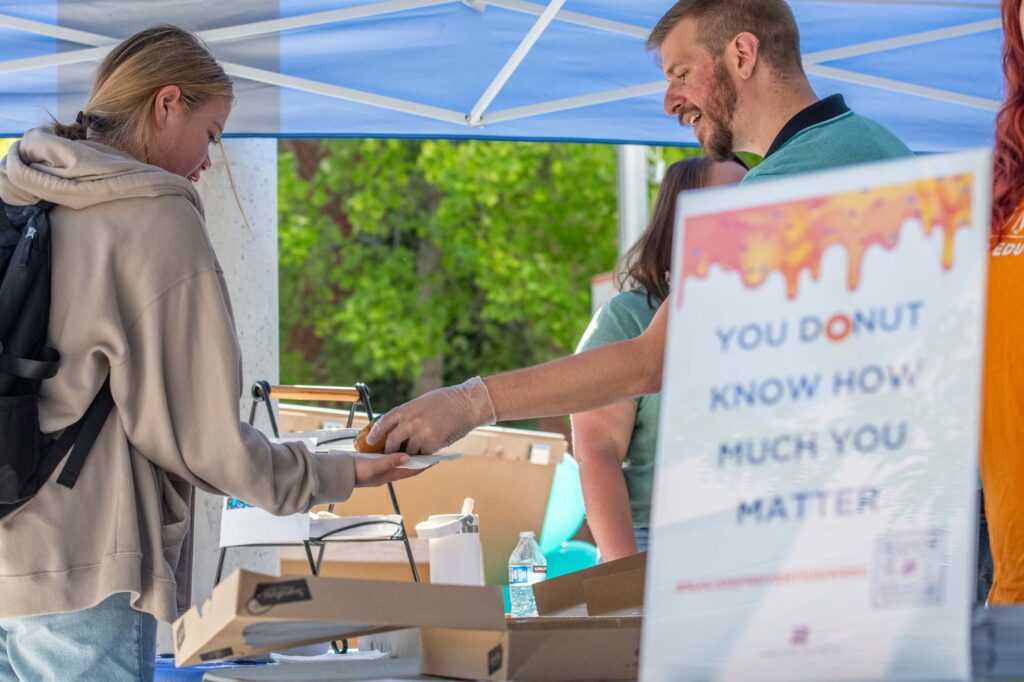
Students will also get to participate in You Donut Know How Much You Matter, an event at which mental health counselors hand out donuts and resource cards. “It’s a chance to see counselors outside of a clinical setting and involved in campus life,” Tassinari said. “The goal is to normalize therapy and show students that counselors are relatable humans.”
Collaborations with faculty at other JED Campuses have led to innovative ideas for how to engage students. It was a conversation with a JED Campus connection that inspired Tassinari to facilitate more campus activities at which students get something to take home, to serve as a physical reminder that hope and help are available to them. The university’s Educational Access Center and TRIO Academic Coaching and Educational Support, for example, sponsored an activity at which students planted a succulent and talked with staff about staying “rooted” during times of stress. Students were able to keep their succulent and were encouraged to practice a mindful moment after the event.
The student buy-in is there, Tassinari said. But building a community of care is a collective effort — from staff, students, faculty, and sometimes even therapy dogs. The commitment from all angles at Boise State, including university president Marlene Tromp, is what has made Suicide Prevention Week — and the institution’s approach to mental health — an increasingly successful venture.
“I’ve been at Boise State for over four years now, and folks are more willing to engage in conversations about mental health, specifically mental health in the classroom and the intersection of learning and supporting student mental health,” Tassinari said. “As a faculty member or instructor, you come in with your own line of research and specialty — mental health isn’t in everyone’s specialty. But folks are willing to get into that space and connect students to the right resources.”
If you or someone you know needs to talk to someone right now, text, call, or chat 988 for a free confidential conversation with a trained counselor 24/7.
You can also contact the Crisis Text Line by texting HOME to 741-741.
If this is a medical emergency or if there is immediate danger of harm, call 911 and explain that you need support for a mental health crisis.